How to Value an Antique: 9 Ways to Find What It's Worth (2026)
You found something old — in an attic, at an estate sale, or passed down through the family — and the obvious question is: what is this antique worth? The honest answer is that no single number exists in a vacuum. An antique is worth what a real buyer will pay for it today, in its current condition. Your job is to find that number using evidence, not guesswork.
This guide walks through nine practical ways to value an antique, in the order professionals actually use them: identify it first, find comparable sales, judge condition and provenance honestly, then decide whether a paid appraisal is worth it. Used together, these steps move you from "no idea" to a defensible value range. You can get an instant first estimate from a photo in seconds, then confirm it with real sold data.
1. Identify the item before you value it
You can't value what you can't name. Valuation is really a two-step process — identification, then pricing — and most bad estimates come from skipping the first step. Before you search for prices, nail down:
- What it is (a serving bowl, a mantel clock, a side chair)
- Who made it (the maker, manufacturer, or pottery)
- When (era or production years)
- The specific pattern, model, or line
The more precisely you can name the piece, the more accurate every later step becomes. "Blue and white plate" returns noise; "Nippon hand-painted moriage plate, c. 1911" returns comparable sales. If you're new to this, our beginner's guide to identifying antiques covers how to read the clues a piece gives you, and for tableware specifically, our guide to identifying antique and vintage china patterns shows how to go from backstamp to pattern name.
2. Read the makers' marks and hallmarks
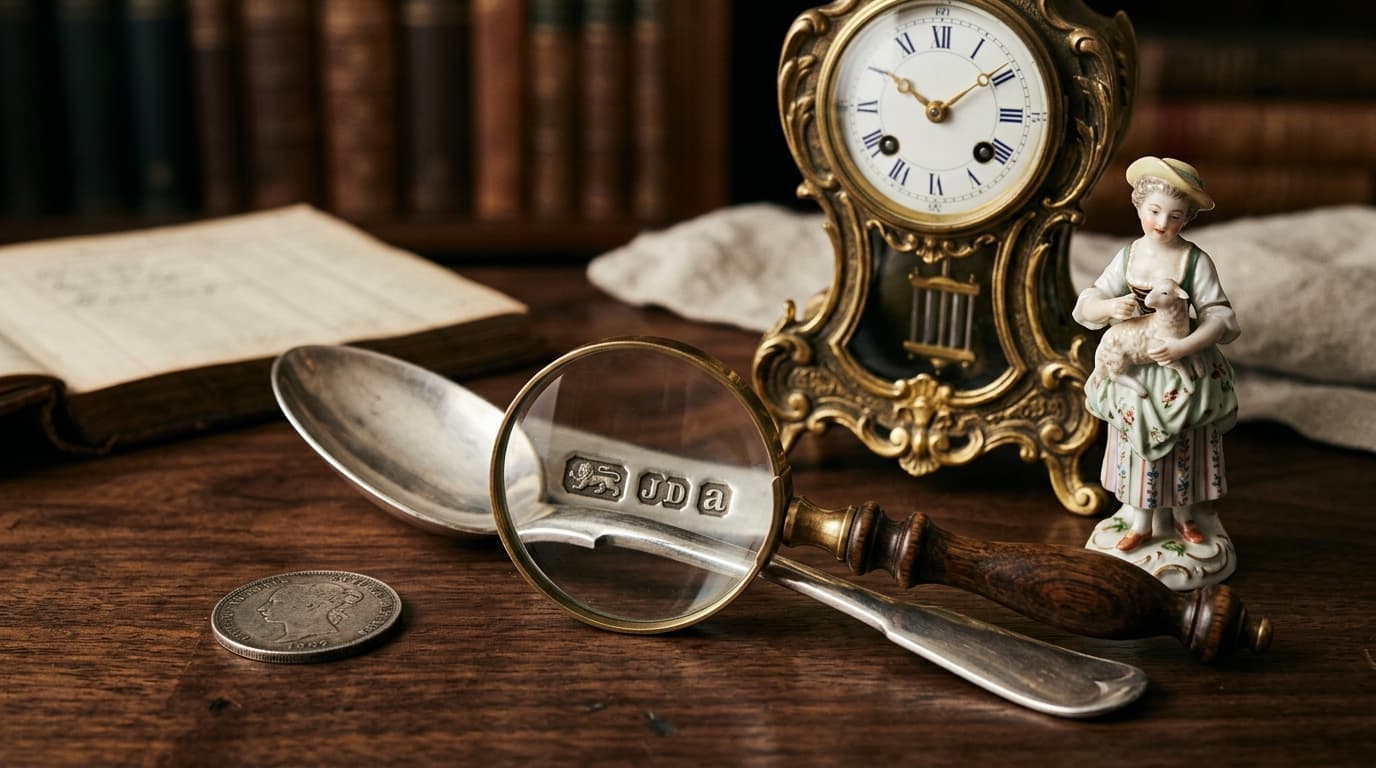
The single most valuable clue on most antiques is the mark — the stamp, signature, hallmark, or backstamp that identifies the maker and often the era. If your piece is silver or gold, the free hallmark identifier looks up purity and plating stamps, describes UK town marks and provides modern date references for 2015–2026. Older dates require a historical reference; the tool does not authenticate metal or assign value. A mark can turn a $5 thrift find into a recognized piece by a sought-after maker, or confirm that a "Tiffany" lamp is a reproduction.
Look on the bottom, back, underside, or inside seams for:
- Manufacturer backstamps (common on china, porcelain, and pottery)
- Silver hallmarks (a sequence of small stamped symbols indicating metal purity, maker, and assay)
- Impressed or molded numbers (mold, pattern, or registration numbers)
- Artist signatures
Marks also help you date a piece, because makers changed their stamps over the decades. Our guide to reading makers' marks and hallmarks shows how to decode the most common ones. If you can't make out a mark, photograph it under raking light — and an identifier app that works from a photo can often recognize it for you.
3. Check eBay sold listings (your best free comps)
Once you know what you have, find out what people actually pay for it. The most reliable free source is eBay's completed/sold listings — not the active listings.
Here's the difference, and why it matters:
| Listing type | What it tells you |
|---|---|
| Active listings | What sellers hope to get (often inflated) |
| Sold listings | What buyers actually paid (real market value) |
To find them, search the exact item, then filter for Sold Items. Sold prices appear in green. Look at several recent sales rather than one outlier, and match condition, size, and markings as closely as you can to your piece.
A realistic value range for a common collectible looks something like a common Pyrex bowl in good condition at roughly US$40–$120, while a rare variant of the same line can sell for far more — a rare promotional or "grail" Pyrex set can run into the thousands (often US$4,000–$10,000+ for the most sought-after examples). See our guide to vintage Pyrex patterns worth money for which prints drive those prices. Always anchor your estimate to what sold, not what's listed.
4. Cross-check auction results
eBay reflects the broad consumer market. For better pieces — fine furniture, listed artists, sterling silver, important porcelain — auction results are the stronger benchmark. Auction houses publish "prices realized," and several free databases aggregate past auction sales.
Auction comps matter because:
- They capture the higher end of the market that rarely appears on eBay
- They're vetted by specialists, so the attribution is usually reliable
- They show a "hammer price" plus buyer's premium, which is closer to true market value for serious pieces
When eBay and auction results disagree wildly, the truth is usually in between — and the gap itself tells you something about demand and authenticity.
5. Grade the condition honestly
Condition is one of the biggest value drivers after maker and rarity, and it's where wishful thinking costs people the most. The same item in mint condition versus damaged condition can differ in value enormously.
Inspect carefully and grade against what you see in sold comps:
- Chips, cracks, and hairlines — even a small chip can sharply reduce value
- Repairs and restoration — sometimes acceptable, often a discount, occasionally a deal-breaker
- Wear, fading, and crazing — expected with age, but heavy wear lowers value
- Completeness — missing lids, parts, or pieces of a set cut value
- Original finish — refinished furniture usually sells for less than original surface
A frank condition assessment is what separates a realistic estimate from a fantasy one. When you compare your piece to sold listings, match condition first.
6. Weigh provenance and rarity
Two identical items can carry very different values because of provenance — the documented history of ownership — and rarity.
- Provenance adds value when an item is tied to a notable owner, maker's archive, original receipts, or a documented estate. Paperwork, labels, and family records all help.
- Rarity drives value when fewer examples exist: short production runs, discontinued patterns, regional variants, or early versions before a design changed. Retired tableware lines are the clearest everyday example — see discontinued Mikasa china patterns and the most valuable Corelle patterns for how replacement demand sets prices.
But rarity only matters if there's demand. A rare item nobody collects stays cheap; a relatively common item in a hot collecting category can outperform. It pays to know which categories currently command strong prices — the most valuable antiques collectors actively look for — before you assume a rare piece is a valuable one.
7. Account for what moves the market
Value isn't fixed — it moves with demand. The same piece can be worth more or less depending on:
- Trends and nostalgia — certain eras and patterns cycle in and out of fashion (mid-century Dorothy Thorpe silver-band glassware, for instance, surged with renewed cocktail-culture interest)
- Where you sell — a specialist auction reaches different buyers than a local flea market
- Region — some makers are prized more strongly in particular markets
- Time of year — seasonal demand affects categories like holiday and outdoor items
This is why a single "book value" is misleading. Treat value as a current range supported by recent comps, and re-check it when you're actually ready to sell.
8. Get an instant first estimate from a photo
All of the above is faster when you start from a confident identification. This is where a photo-based tool earns its place in the process. Histora gives you an instant first estimate — point your phone at the piece, capture the mark, and get a likely identification plus a ballpark value range in seconds.
Think of it as the first step, not the last word. The app's instant estimate tells you whether you're holding a $10 piece or a $1,000 piece, and what to search for next. You then confirm that number with the sold-listing and auction comps above. For everyday items, a quick photo check is often all the valuation you need; for promising pieces, it points you straight at the right comparable sales.
9. Decide between a free and a paid appraisal
Most items never need a paid appraisal. Match the level of effort to the stakes:
| Situation | Best valuation approach |
|---|---|
| Curiosity / decluttering | Free: photo app + eBay sold listings |
| Selling a mid-value item | Free comps + auction results |
| Insurance, estate, or dispute | Paid written appraisal by a qualified appraiser |
| One-of-a-kind / very high value | In-person specialist or auction-house valuation |
Free options include photo-identifier apps, eBay sold listings, free auction databases, and informal "valuation day" events some auction houses host — all no-cost routes to a free antique appraisal online before you decide whether a paid one is worth it.
Paid appraisals make sense when you need a defensible figure on paper — for insurance, estate settlement, donation, or a legal matter. Fees vary by appraiser, region, and whether you need a verbal opinion or a formal written report — appraisers typically charge an hourly or flat per-item rate rather than a percentage of value, and online specialist services illustrate the lower end at roughly US$10–$30 per item (confirm current rates before you commit). For insurance and estate work, choose an accredited appraiser rather than a dealer who may have a stake in buying the piece.
Putting it all together
A solid antique valuation is a stack of evidence, not a single guess: identify the piece, decode the mark, find what identical items actually sold for, grade the condition honestly, factor in provenance and demand, and escalate to a paid appraisal only when the stakes call for it. Start with an instant photo estimate to know what you're holding, then let real sold data turn that estimate into a number you can defend.
Frequently Asked Questions
Identify your antique instantly
Snap a photo with Histora to get an instant first estimate of your item's value, origin, and history — then dig deeper with the guides above.