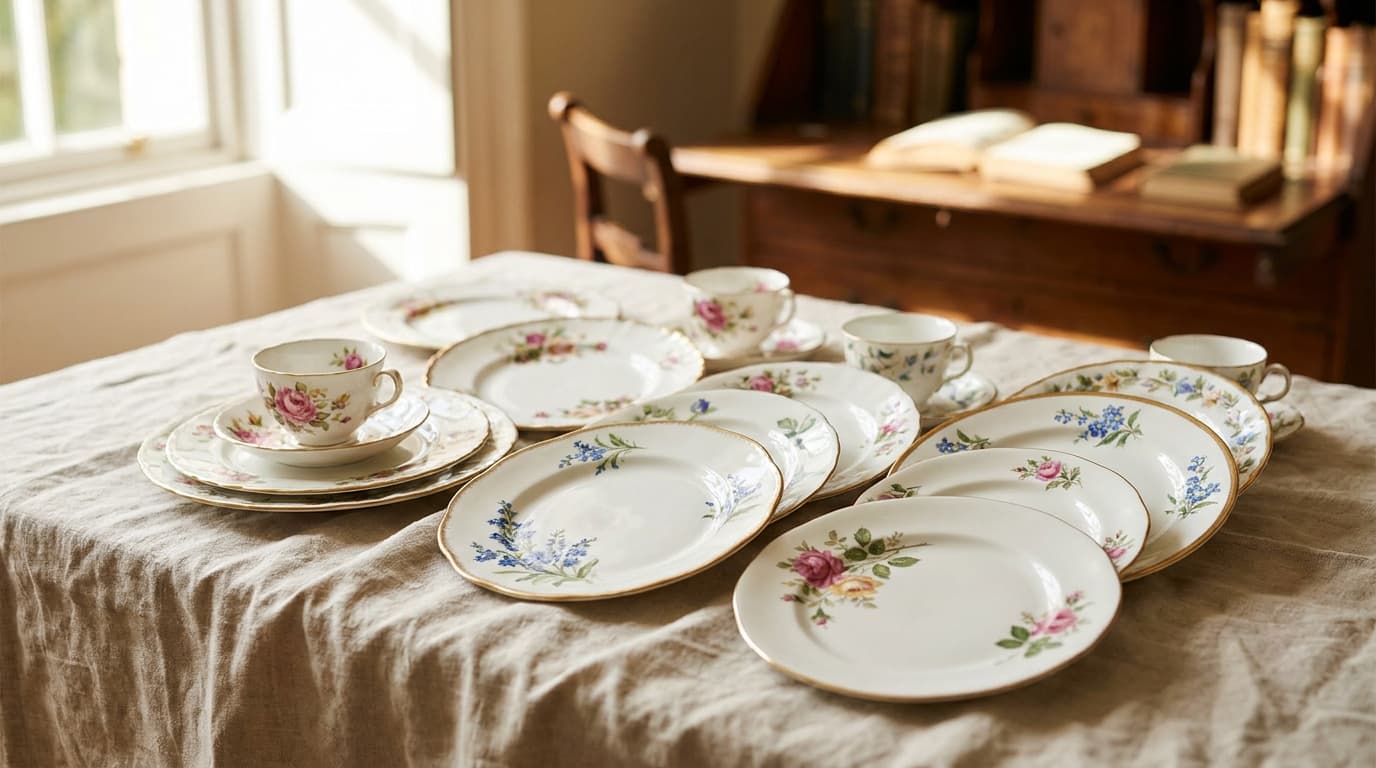
Antique & Vintage China Patterns: How to Identify and Value (2026)
If you have inherited a cabinet of dishes or pulled a delicate plate from a yard-sale box, two questions usually follow fast: what is this pattern called, and is my china worth anything? This guide walks you through identifying china the way an appraiser does — reading the backstamp, telling bone china apart from porcelain and ironstone, tracing a manufacturer's mark, finding the pattern name, and understanding what actually drives value up or down. From here you can branch off to our deeper guides on specific makers like Mikasa, Corelle, Nippon, and Pyrex.
The short version: turn the piece over, photograph the mark and the pattern, identify the maker and body type, match the pattern, then judge condition and set completeness. Do those steps in order and you will know more than most sellers do.
Start with the backstamp
The single most useful thing on any piece of china is the backstamp — the printed or impressed mark on the underside. A good backstamp can tell you the maker, the country of origin, sometimes the exact pattern name, and a rough production date.
When you examine a mark, note these elements:
- Maker name or logo — the brand, often with a crest, crown, or wreath.
- Pattern name or number — printed words like "Garland" or a code like "5023."
- Country of origin — wording such as "Made in England," "Nippon," or "Japan" is a strong dating clue (see the timeline below).
- Body designation — phrases like "Bone China," "Fine China," "Ironstone," or "Porcelain."
- Extra symbols — registry numbers, date codes, and backstamp design changes that map to specific eras.
A backstamp is a compressed history lesson. Reading one well is a skill that carries across every category of ceramics, which is why we cover it in depth in our guide to reading makers' marks and hallmarks. If your piece has no mark at all, that is itself a clue — many early, utilitarian, or unmarked secondary-line wares were never stamped, and identification then leans on body, shape, and decoration.
Bone china vs porcelain vs ironstone
Knowing the body type narrows the maker list, hints at age, and shapes value expectations. Here is how the three most common categories differ.
| Body type | Look & feel | Quick test | Typical era / use |
|---|---|---|---|
| Bone china | Thin, warm ivory tone, very translucent | Glows when held to light; rings with a clear tone | English specialty from late 1700s on; fine dining ware |
| Porcelain (hard-paste) | White, smooth, glassy, fairly translucent | Translucent but cooler/whiter than bone china | Worldwide; both antique and modern |
| Ironstone / stoneware | Heavy, opaque, durable, often off-white | Does not glow; dull thud when tapped | 1800s onward; sturdy everyday and hotel ware |
The light test is your fastest tool: hold the piece up to a bright window or lamp. Bone china is the most translucent and usually shows a warm glow, while ironstone stays solid and opaque. The tap test backs this up — bone china and fine porcelain ring, ironstone thuds. When in doubt, the backstamp often spells out the body type, and that printed word beats any guess.
How to find the pattern name
Once you know the maker and body, identifying the pattern unlocks lookups and comparables. Work through these in order:
- Read the backstamp for a name or number. Many 20th-century makers printed the pattern name or a pattern code right under the logo. A bare number still works — search the maker plus that number.
- Describe the decoration precisely. Note the rim/trim color (gold, platinum, a colored band), the border motif, the central image, and the flower or scene style. "Pink roses with a gold scalloped rim" is a searchable fingerprint.
- Match against a replacement-china database. Services that sell discontinued patterns let you browse by maker and visual traits — invaluable when the name was never printed.
- Photograph two shots: the backstamp, and the full plate face in even light. Those are the two images almost every identification needs.
This is exactly where an AI identifier earns its place. Histora lets you photograph the backstamp and the pattern and get an instant first read on the likely maker, era, and pattern direction — a fast starting point you then confirm against a database or specialist. Treat it as the quick first estimate, not the final word.
What drives china value up — and down
No honest guide hands you a price without seeing the piece, and we never invent figures. But the factors that move value are consistent and worth learning.
Pushes value up:
- Prestige maker — established names with collector followings.
- Rare or short-run patterns — including discontinued lines people are still trying to complete.
- Hand-painted, signed, or artist decoration rather than transfer prints.
- Completeness — a full service with serving pieces beats a stack of loose dinner plates.
- Strong condition — bright glaze, intact gilding, no chips or hairlines.
- Demand — a pattern actively sought to fill out existing sets.
Pulls value down:
- Crazing, chips, cracks, and worn gold — condition flaws compound quickly.
- Common, mass-market patterns with little scarcity.
- Incomplete or mismatched sets.
- Repairs, stains, and heavy use marks.
For everyday department-store china, a complete set might land in a typical sold range of about US$150–$400 (for a mid-century department-store service for eight in good condition), while a rare hand-painted antique service can sit far above that. The honest answer to "is my china worth anything" almost always starts with which maker and pattern — so identify first, value second. For the full appraisal framework, see how to value an antique.
A quick country-of-origin dating shortcut
Origin wording on the backstamp is one of the fastest age cues for English and Japanese wares:
- No country named — often pre-1891 (when US import law began requiring country marking).
- "Nippon" — used on Japanese exports roughly 1891–1921; a strong antique signal explored in our Nippon hand-painted porcelain guide.
- "Japan" or "Made in Japan" — generally after 1921.
- "Bone China" printed in the mark — points to the 20th century, since the wording became standard later.
- "England" vs "Made in England" — the latter skews later; phrasing shifts help bracket a date range.
These are guideposts, not guarantees. A few makers reused marks for decades and a small number were faked, so always cross-check the body, shape, and decoration before locking in a date.
Where to go next: maker-specific guides
China is a huge field, so this hub points you to focused guides for the makers people ask about most:
- Mikasa — a hugely popular mid-to-late 20th-century brand whose retired lines drive a busy replacement market. Our discontinued Mikasa china patterns guide covers which patterns collectors chase.
- Corelle — the lightweight, near-unbreakable tableware whose vintage prints have a devoted following. See most valuable Corelle patterns for the names that command a premium.
- Nippon — hand-painted Japanese porcelain from the antique export era, with elaborate gilding and beading. Start with Nippon hand-painted porcelain.
- Pyrex — technically glassware rather than china, but it lives in the same kitchen cabinets and the same collector conversations. Our vintage Pyrex patterns worth money guide breaks down the prints buyers hunt.
A note on glass while we are here: collectors often ask for a vintage crystal glass identification chart to sort lead crystal from pressed glass and to match cut patterns. The same logic applies — check for a maker's acid-etched or paper label, judge clarity and weight (true lead crystal is heavier and rings longer), and match the cut motif against a maker's catalog. The principle that unites china and crystal is simple: identify the maker and pattern first, then assess condition and completeness, then talk value.
Putting it together
Identifying china is a short, repeatable routine. Flip the piece, read the backstamp, settle the body type with the light and tap tests, pin down the pattern name through the mark or a visual match, then weigh maker, rarity, condition, and set completeness. A china identification app like Histora compresses the first pass into a single photo, giving you an instant first estimate you can confirm with a database or specialist. Run that loop on any plate in your cabinet and you will know its name, its likely age, and what to look for next — whether the trail leads to Mikasa, Corelle, Nippon, or the glass shelf.
Frequently Asked Questions
Identify your antique instantly
Snap a photo with Histora to get an instant first estimate of your item's value, origin, and history — then dig deeper with the guides above.


Related Guides
- Item GuideDiscontinued Mikasa China Patterns Worth Money (2026)Read guide
- Item GuideMost Valuable Corelle Patterns (Identification & Value, 2026)Read guide
- Item GuideNippon Hand-Painted Porcelain: Identification & Value (2026)Read guide
- IdentificationHow to Read Antique Makers' Marks & Hallmarks (With Examples, 2026)Read guide