Vintage Pyrex Patterns Worth Money (Value Guide 2026)
If you have a cabinet of old opal-glass Pyrex bowls and dishes, some of it may be worth far more than you think, and some of it is simply nice vintage kitchenware. The difference comes down to the pattern, the condition, and how rare the piece is. This guide shows you how to identify the vintage Pyrex patterns worth money, how to read the backstamps and numbers on the bottom, and what actually drives collector value up or down.
The short version: a handful of patterns, especially scarce promotional designs, command real collector interest when they are bright and undamaged. Most everyday patterns are affordable. Knowing which is which starts with recognizing the pattern on sight and confirming it with the markings underneath.
What makes vintage Pyrex valuable
Three factors decide nearly every Pyrex valuation:
- Pattern. Some patterns were mass-produced for years; others were short-run promotionals sold for a single season or region. Scarcity of the pattern is the biggest single driver.
- Condition. Collectors want bright color, a glossy surface, and no damage. Fading from dishwashers, utensil scratches, chips, and cracks all pull value down hard.
- Completeness and form. A full graduated bowl set, or a less common shape like a divided dish or a specific casserole with its original lid, tends to outperform a lone common bowl.
Demand also shifts over time as a pattern trends among collectors, so two pieces of identical rarity can sell differently depending on the moment. These are the same forces behind almost any collectible, and you can read more about applying them in our guide on how to value an antique. Pyrex sits firmly in the affordable-but-collectible tier, which is exactly why it shows up so often among the most valuable antiques to look for.
How to read Pyrex backstamps and numbers
Flip any piece over. The underside is where Pyrex tells you most of what you need to know.
You are usually looking for three things:
- The Pyrex logo and wording. The logo style and the way the brand name was written changed across the decades. The shape of the lettering and any accompanying text (such as country of origin and trademark notation) help date the piece even when the surface pattern has faded.
- A mold or item number. Opal Pyrex pieces carry a number that corresponds to a specific shape and size, such as a particular bowl in a nesting set or a specific casserole. Matching that number to a known shape confirms what you have and helps you assemble or verify a set.
- Country of origin. This narrows down where and roughly when a piece was made.
Treat the backstamp the way you would a maker's mark on any antique: it dates and authenticates the piece. The same logic we cover in our guide to makers' marks and hallmarks applies here, just on mid-century kitchenware instead of silver or porcelain. If the pattern is worn but the stamp is crisp, the stamp is your most reliable identifier.
A practical tip: photograph the backstamp in good light. A clear shot of the logo and number lets you compare against documented examples and rule out later reissues or reproductions.
Notable vintage Pyrex patterns worth money
Below are patterns collectors actively seek, with recognition cues for each. Because real sold prices move constantly with condition and demand, treat every figure below as a typical sold range at the time of writing, not a fixed quote — always check current sold listings before you buy or sell.
Gooseberry
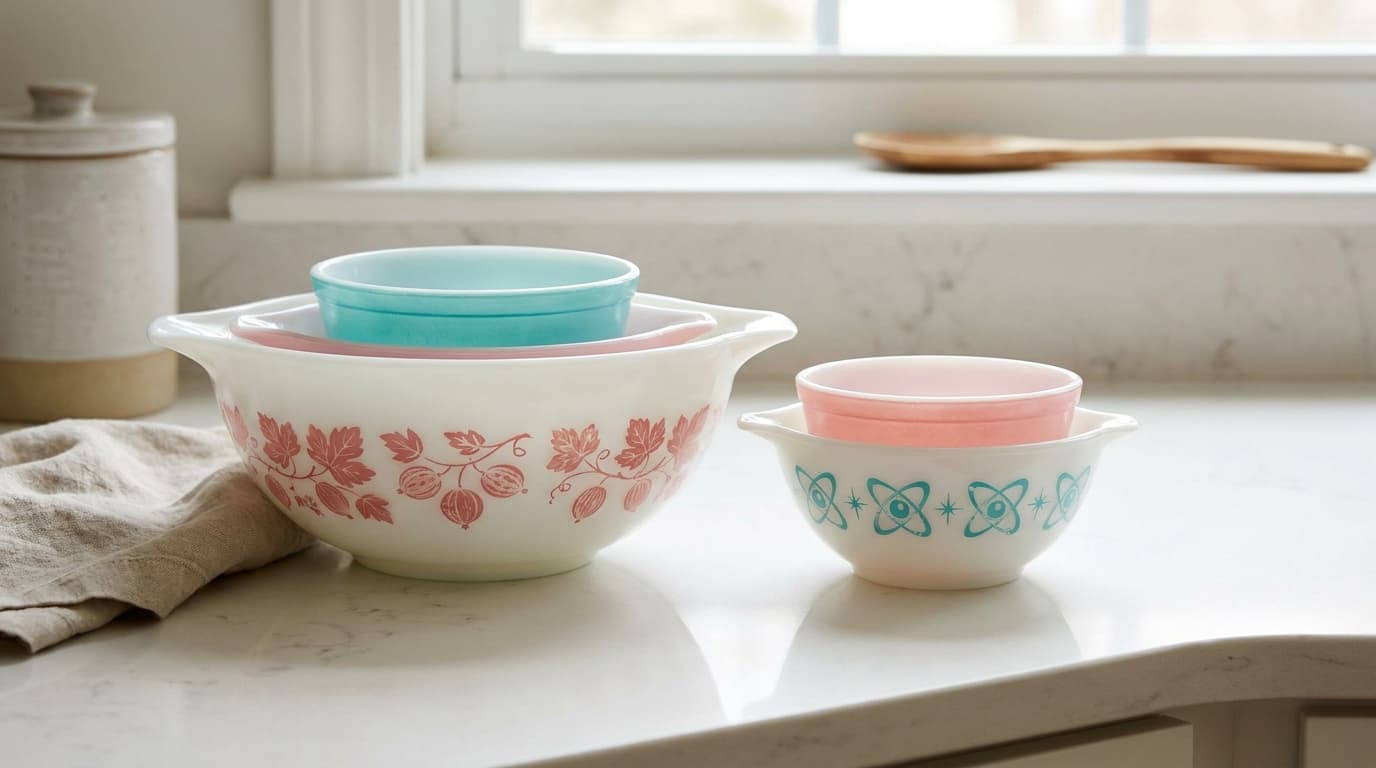
One of the classic early patterns, Gooseberry shows a repeating berry-and-leaf motif, most familiar in pink-on-white and black-on-white (and other colorways). Recognition cues: small rounded berries clustered with fine stems and leaves, running as a band around bowls and dishes. Cinderella bowls (with the wide pour-and-grip lip) and casseroles in this pattern are common collecting targets.
As of writing, single Gooseberry bowls in good condition typically sell in the US$40–$120 range, while a complete four-bowl nesting set tends to land around US$350–$750.
Pink Daisy
A pink-on-white daisy pattern, with the promotional pink versions being the more sought-after. Recognition cues: open daisy flowers with rounded petals and a contrasting center, scattered or banded against opal white. Promotional Pink Daisy pieces in bright, unfaded condition are the ones that draw collector attention.
As of writing, promotional Pink Daisy (and Pink Gooseberry) pieces typically sell for around US$30–$150 each, with complete pink sets in the US$300–$450 range.
Lucky in Love
Among the most famous and rarely seen Pyrex patterns. A 1950s promotional design featuring green four-leaf clovers and pink hearts on white. Recognition cues: the combination of hearts and clovers is unmistakable and unique to this pattern; it most often appears on a casserole-style piece. Because it surfaces so infrequently, Lucky in Love is a benchmark for "grail" Pyrex.
As of writing, this grail pattern typically commands a sold range of around US$4,000–$10,000+. (A widely repeated US$22,100 figure is sometimes cited, but that was a retracted bid rather than a completed sale, so treat it with caution.)
Atomic Eyes (Snowflake variant / promotional)
A mid-century promotional pattern with a distinctive repeating shape that collectors nicknamed "atomic eyes." Recognition cues: a turquoise (or similar) repeating elongated eye-like motif on white, giving an unmistakable atomic-age look. Its retro graphic appeal keeps demand strong among mid-century collectors.
As of writing, single Atomic Eyes bowls typically sell in the US$300–$400 range, while a complete chip-and-dip set with its original bracket can reach up to around US$1,400.
Other promotional and short-run patterns
Beyond the headliners, Pyrex released many promotional patterns sold briefly or in limited regions. These short runs are where surprise value hides. Recognition cues vary, but the tells are: an unusual color combination, a pattern you cannot immediately match to a long-running standard line, and a shape (like a chip-and-dip set, divided dish, or specific casserole) that was sold as a one-off promotion.
Values vary widely by scarcity. As a baseline, a common Primary Colors set of four typically sells for around US$60–$200, while genuinely scarce short-run promotionals climb well beyond that — the rarer the promotion, the more the price is rarity-driven rather than tied to any fixed market level.
If you cannot identify a pattern at all, that unfamiliarity itself is a clue it may be a short-run promotional worth a closer look.
Quick reference: recognition cues
| Pattern | Key visual cue | Why collectors want it |
|---|---|---|
| Gooseberry | Berry-and-leaf band, pink or black on white | Classic early pattern, multiple desirable forms |
| Pink Daisy | Open pink daisies on white | Promotional versions are scarcer |
| Lucky in Love | Hearts + four-leaf clovers | Rare 1950s promotional, "grail" status |
| Atomic Eyes | Repeating eye-like atomic motif | Strong mid-century graphic appeal |
| Unknown promotionals | Unusual colors/shapes, no standard-line match | Short runs hide surprise value |
How condition is judged
Two pieces of the same pattern can differ wildly in value based on condition alone. When you grade a piece, look for:
- Color brightness. Crisp, saturated color beats a washed-out, dishwasher-dulled surface.
- Surface gloss. A glossy, un-scratched finish is worth more than one cloudy with utensil marks.
- Damage. Chips, cracks, and flea-bites on rims reduce value sharply.
- Pattern completeness. Worn-away or partially missing pattern is a major detractor.
- Set integrity. For nesting bowl sets, a complete graduated run in matching condition outperforms mismatched survivors.
Be honest with yourself here. A rare pattern in rough shape is still a rough piece, and collectors price it accordingly.
How Histora helps
If you are staring at a backstamp you cannot place or a pattern you have never seen, snap a photo and run it through Histora for an instant first identification and value estimate. It is the fast way to learn whether you are holding an everyday bowl or a promotional piece worth researching further. Treat that estimate as your starting point, not the final word: confirm scarce or high-value patterns against recent sold listings and, when the stakes are high, a specialist. Histora is the "instant first read," and the steps in this guide, plus our how to value an antique walkthrough, take it the rest of the way.
Where Pyrex fits among collectibles
Vintage Pyrex is approachable: most pieces are inexpensive, identification is doable at the kitchen counter, and the rare exceptions are exciting precisely because they hide in ordinary cabinets. If you enjoy this kind of pattern-spotting, the same skills carry over to other mid-century kitchen and tableware lines covered in our vintage and antique china patterns hub — the most valuable Corelle patterns guide applies the identical pattern-and-condition logic to another cabinet staple.
Start with the pattern, confirm it with the backstamp and number, grade the condition honestly, and only then reach for a value. That sequence keeps you from overpaying for a faded common bowl, and from selling a rare promotional piece for a fraction of what it deserves.
Frequently Asked Questions
Identify your antique instantly
Snap a photo with Histora to get an instant first estimate of your item's value, origin, and history — then dig deeper with the guides above.