How to Read Antique Makers' Marks & Hallmarks (With Examples, 2026)
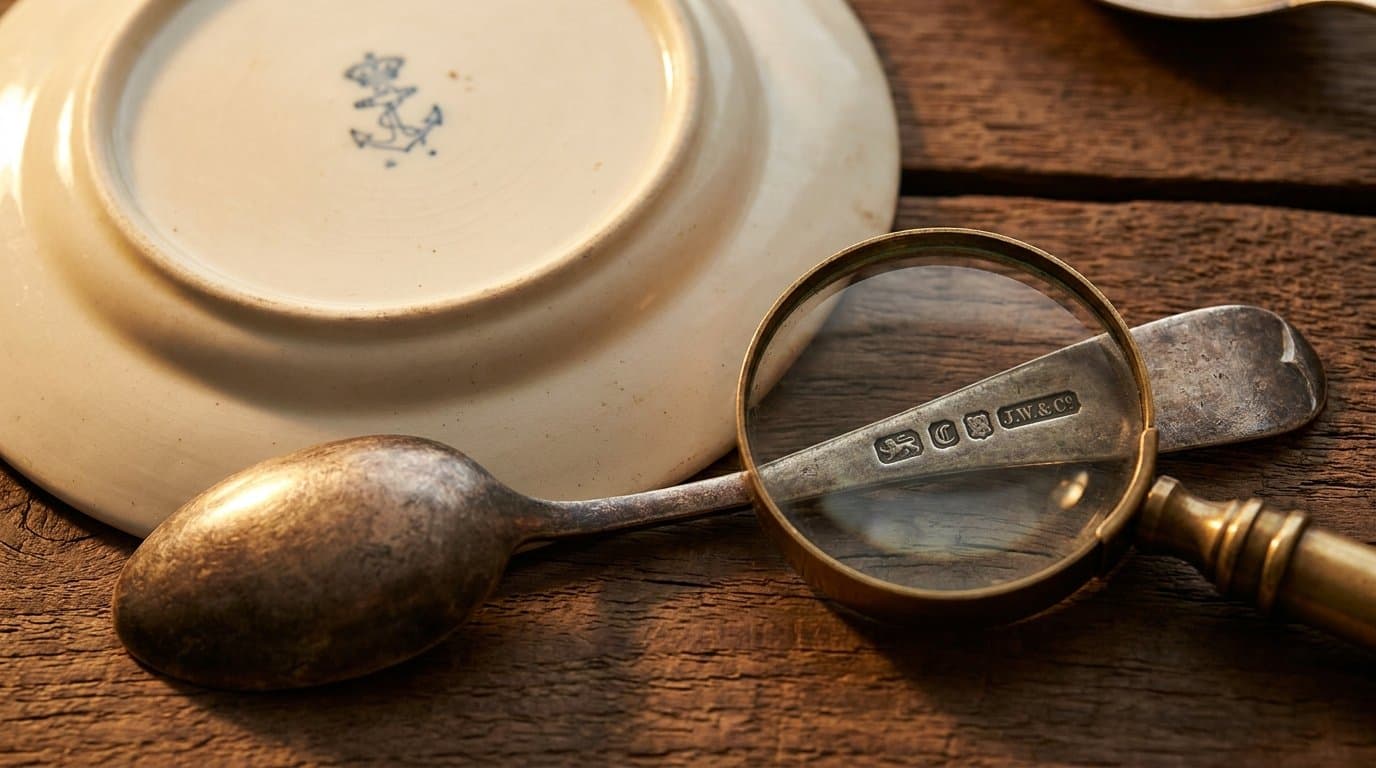
A maker's mark is the single most useful clue on most antiques. Turn a plate, a spoon, or a vase over, and the small stamp on the base can tell you who made it, where, and roughly when — which is the foundation of identifying and valuing almost anything. This guide explains how marks are structured, how to read porcelain, silver, and glass marks specifically, and how to move from "I see a symbol" to "I know what this is." It is the hub that many of our item guides link back to, so bookmark it.
The short version: read a mark by breaking it into parts — the maker, the place, the date, and any quality or pattern codes — then verify the mark against the piece itself. A mark never works alone. It is one piece of evidence you weigh alongside form, materials, and condition, exactly as described in our beginner's guide to identifying antiques.
What a mark is — and what it is not
There are two terms people use interchangeably that actually mean different things.
A maker's mark identifies the producer. It can be a written company name, a printed backstamp, an impressed monogram, a painted symbol, or an incised signature. Its whole job is to say "we made this."
A hallmark is a formal, often legally regulated stamp that certifies something — most famously the precious-metal content of silver and gold. A British silver hallmark is a small cluster of symbols that, read together, tells you the metal standard, the assay office that tested it, the year it was tested, and the maker. So a hallmark usually contains a maker's mark, but it adds guaranteed information a plain maker's mark does not.
Keep the distinction in mind: on pottery and glass you are usually reading maker's marks; on silver you are reading true hallmarks plus a maker's mark.
How marks are structured: the four questions
Whatever the material, a useful mark answers some combination of four questions. Train yourself to look for each one.
| Element | What it tells you | Typical form |
|---|---|---|
| Who | The maker or factory | Name, logo, monogram, crest |
| Where | Country or town of origin | "England", "Bavaria", an assay-office town symbol |
| When | The production period | Date letter, date code, or a mark style used only in certain years |
| What | Pattern, quality, or registration | Pattern name/number, "Sterling", registration mark |
You rarely get all four on one piece. The skill is reading the ones you do have, and knowing what each implies. A country name, for example, is a strong dating clue all by itself — see the next section.
Reading porcelain and pottery marks
Ceramic marks are the richest and most varied category, because factories changed their backstamps frequently — which is great news for dating.
Step 1 — Describe the mark physically. Before you read any words, note how the mark was applied:
- Printed (transfer-printed): a flat, ink-like mark, common from the 19th century onward.
- Impressed: pressed into the clay before firing, leaving a recessed mark; typical of earlier and of certain stoneware makers.
- Painted: applied by hand, often with slight irregularity; common on early and on higher-end porcelain.
- Incised: scratched into the surface, frequently a signature on studio or art pottery.
The method alone narrows the era and the type of pottery.
Step 2 — Read the country clue. A country of origin in the mark is one of the most reliable dating shortcuts:
- A mark naming a country in English (e.g., "Germany," "Nippon" for Japan) generally indicates production for export after the 1891 McKinley Tariff Act required country-of-origin labeling.
- "Made in [Country]" phrasing typically points even later, broadly to the 20th century.
- No country at all can suggest a piece made before that requirement — though it can also simply mean a domestic-market piece, so never lean on this single clue.
Step 3 — Identify the maker. Now read or match the symbol itself. Some marks are literal (a full factory name), while many famous ones are emblematic — crossed lines, a crown, an anchor, a shield, or a beehive shape are all classic device-style porcelain marks that map to specific houses and periods. Because the same factory often used a dozen variations over its life, matching the exact variant is what lets you date the piece tightly.
Step 4 — Note pattern and number codes. Extra numbers or names alongside the maker's mark frequently encode the pattern or shape, which is how you connect a piece to a named line. Our china patterns identification guide goes deeper on turning those codes into a specific pattern name, and maker-specific guides like discontinued Mikasa patterns and Nippon hand-painted porcelain show how a single backstamp narrows both the era and the line.
A practical example of the reasoning: imagine an unfamiliar floral plate with a printed crown-and-name backstamp that includes the word "England" and a pattern number. From that alone you can infer a likely post-1891 English maker, a transfer-decorated body, and a named pattern you can look up — long before you've confirmed the exact factory.
Reading silver hallmarks
Silver is where marks become a genuine code, and it is the most rewarding to learn. British sterling is the classic system, and most other traditions echo parts of it.
A full British hallmark is read as a small row of distinct stamps:
- Standard mark — certifies the metal. The walking lion (lion passant) indicates sterling standard in England.
- Assay office (town) mark — a symbol for the city that tested the piece (for example, a leopard's head, an anchor, or a castle, each tied to a specific office).
- Date letter — a single letter in a particular font and shield outline, marking one assay year. Because the alphabet cycles repeat over the centuries, you read the letter with the town mark to land on the right year on a date chart. Our free hallmark identifier looks up purity and plating stamps and includes modern UK date references for 2015–2026. For antique date letters, use the linked assay-office historical references.
- Maker's mark — the silversmith's initials in a shaped punch.
- Duty / commemorative marks — a sovereign's head appears in certain periods, indicating duty was paid, which is itself a dating clue.
American silver works differently: it generally lacks a date-letter system, and the word "Sterling" (or the numeric "925") plus a maker's name or symbol does the heavy lifting. Our full guide to antique silver and silverware identification covers sterling, silverplate and coin silver in depth. "Coin" or "900" indicates the older coin-silver standard. Continental European silver uses its own purity numbers and national marks.
Why this matters for value: condition, maker, and rarity drive silver prices, and the hallmark is what pins down maker and era. If you need typical figures, gather them from real sold data rather than guessing — but to illustrate how completeness shifts value, a single hallmarked Georgian sterling teaspoon often sells for only about US$25–$70 (barely above its melt value), whereas a matched Georgian set of six can bring roughly US$200–$600 or more, three to five times the per-spoon rate, with named makers commanding still higher. The full identification workflow for flatware and holloware follows the same read-the-hallmark-first logic covered here.
Reading glass marks
Glass is the trickiest category, because much antique glass is unmarked. When marks do exist, they take a few forms:
- Acid-etched or stamped signatures — high-end art glass and crystal makers signed pieces, sometimes faintly; raking light across the base helps these appear. Lalique is the classic case where the signature itself dates the piece — our Capodimonte and Lalique identification guide covers how the R. Lalique versus Lalique France distinction changes value.
- Molded marks — a maker's name or logo raised in the glass itself, common on pressed and depression-era glass.
- Paper labels — many makers used only foil or paper labels, which usually wore off, so their absence proves nothing.
When there is no mark, you identify glass by color, pattern, mold seams, weight, the pontil mark on the base, and wear — the same construction-and-materials reasoning you use for unmarked pottery and furniture. Mid-century kitchen glass is a good example: our guide to vintage Pyrex patterns worth money shows how the molded backstamp and pattern together date and identify a piece even when the surface print has faded.
When there is no mark — or a suspicious one
Two situations trip up beginners.
No mark at all. This is normal and common. Plenty of authentic antiques were never marked. Shift your attention to construction: hand-cut dovetails, tool marks, oxidation, genuine wear in logical places, and period-appropriate materials. Form and craftsmanship identify unmarked pieces.
A mark that looks too good. A famous mark is exactly what a faker copies. The defense is consistency: does the right mark sit on the right body? A celebrated porcelain mark on a piece whose glaze, weight, or footrim is wrong for that factory is a red flag, not a windfall. Treat the mark as a hypothesis you then test against everything else, a principle we return to throughout our how to value an antique guide.
Building a reference workflow
You do not need to memorize thousands of marks. You need a repeatable process:
- Photograph the mark well — straight-on, filling the frame, in soft even light, with a second raking-light shot to catch impressed or worn detail.
- Describe before you name — method (printed/impressed/painted/incised), color, words, country, and any numbers.
- Extract the four questions — who, where, when, what.
- Match against a reference — a marks dictionary or database, narrowing by the clues you already extracted rather than browsing blindly.
- Verify against the piece — confirm the body, materials, and construction agree with what the mark claims.
How Histora helps
Marks are small, worn, and easy to misread, which is exactly where an instant first read saves time. Photograph the base and run it through Histora to get an immediate best-guess on the likely maker, origin, and era — a fast starting point instead of a blank search box. This pairs naturally with our walkthrough on how to identify an antique from a photo: get the AI's first estimate, then confirm it against a dedicated marks reference and the physical evidence before you rely on it for value. Histora is the first step that points you in the right direction, not the last word.
Read marks this way long enough and it becomes second nature: you stop seeing a mysterious symbol and start seeing a compact little record of who made a thing, where, and when.
Frequently Asked Questions
Identify your antique instantly
Snap a photo with Histora to get an instant first estimate of your item's value, origin, and history — then dig deeper with the guides above.


Related Guides
- Beginner's GuideHow to Identify Antiques: Complete Beginner's Guide for 2026Read guide
- ValuationHow to Value an Antique: 9 Ways to Find What It's Worth (2026)Read guide
- IdentificationHow to Identify an Antique From a Photo (Free Methods, 2026)Read guide
- Item GuideAntique Silver & Silverware: How to Identify and Value (2026)Read guide