How to Identify an Antique From a Photo (Free Methods, 2026)
You found something at an estate sale, in a relative's attic, or at the back of a cupboard, and you want to know what it is without leaving the room. The fastest way to start is a photo. In 2026 you can identify antiques by photo online free using tools you already have, and the results are good enough to point you in the right direction within seconds.
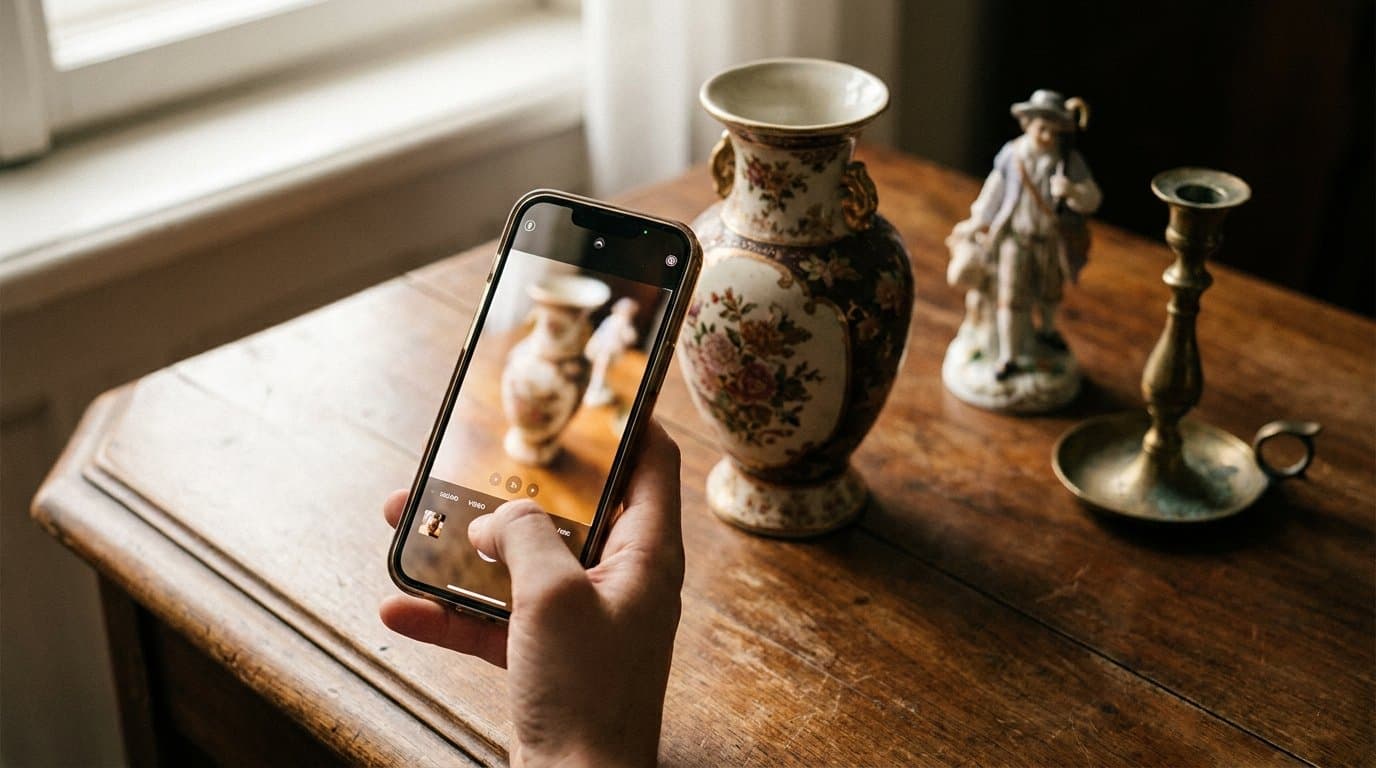
Here is the short answer: take a clear, well-lit photo of the whole object plus a close-up of any maker's mark, then run it through Google Lens, a reverse image search, or a dedicated AI antique identifier. Each method has strengths. This guide compares them honestly, shows you when each one wins, and gives you the photo techniques that actually change your accuracy.
The three ways to identify an antique from a photo
There are three practical approaches, and most experienced collectors use a combination rather than relying on one.
| Method | What it does best | Where it falls short | Cost |
|---|---|---|---|
| Google Lens | Recognizes the object and finds visual matches across the whole web | Generic results; mixes antiques with modern lookalikes | Free |
| Reverse image search | Finds copies of your exact photo (listings, catalogs, forums) | Needs an existing match online; weak on unique items | Free |
| AI antique identifier | Interprets maker, era, and style using antiques-specific training | First estimate only; still needs verification | Free tier, then paid |
None of these replaces a human appraiser for high-value items. What they do is collapse the slow part: figuring out what you are even looking at so you can research the right thing.
Method 1: Google Lens (best free all-rounder)
Google Lens is the most capable free tool for general identification. Point your camera or upload a photo, and it recognizes the object, reads any text in the image, and surfaces visually similar results, including shopping and auction listings.
For antiques, Lens shines when your piece resembles something already documented online, such as a well-known pattern, a common form, or a branded item. It also reads marks surprisingly well, so a close-up of a stamped hallmark can pull up matching results directly.
The weakness is that Lens does not know it is looking at an antique. It happily mixes a 1900s pressed-glass dish with a brand-new reproduction sold last week, because to a general visual model they look the same. You get breadth, but you do the interpretation.
Method 2: Reverse image search
A true reverse image search answers a narrower question: where else does this exact image, or a near-copy, appear? That is powerful when your item has been photographed and listed before. If a similar piece sold on an auction site or is catalogued in a collector forum, reverse image search can land you on that page directly, which is gold for research.
It is weaker for genuinely unique or unusual objects with no online twin, and it can be thrown off by your background and lighting. Think of it as a "find the listing" tool rather than a "tell me what this is" tool.
Method 3: AI antique identifier apps
A dedicated AI identifier is trained specifically on antiques and collectibles, so instead of generic web matches it tries to tell you the likely maker, era, material, and style. This is where specialist tools pull ahead of general search: they understand that a particular foot, glaze, or mark pattern signals a specific period. If you want a deeper look at how that recognition works under the hood, see our explainer on AI technology for antique identification.
The trade-off is honesty about scope. An AI gives you a confident-sounding first estimate, and that estimate is a hypothesis, not a verdict. The good tools make this clear and push you toward verification. We compare the leading options in our roundup of the best antique identifier apps if you want to see how they stack up, and we go deeper on two of the most-searched ones in our AntiqSnap review and Curio review.
How Histora's photo flow works (honestly)
Histora is built around the two-step reality of photo identification: an instant first estimate, then verification.
- Snap and get an instant estimate. You photograph the item, and Histora returns a likely identification, including probable maker or style, era, and material, within seconds. This is the fast, satisfying part, and it is genuinely useful for narrowing the field.
- Verify before you trust it. Histora then guides you to confirm the estimate against the details that matter, especially the maker's mark, construction, and condition. Reading marks is its own skill, and our guide to makers' marks and hallmarks walks through how to decode them so the AI's first guess can be confirmed or corrected.
We are deliberate about this framing. A photo-based estimate is the start of identification, not the end. Anyone who tells you a single snapshot delivers a guaranteed maker and value is overselling. The honest pitch is speed plus a clear path to confidence.
Photo tips that actually improve accuracy
Most "the tool got it wrong" complaints trace back to the photo, not the algorithm. Get these right and every method above improves at once.
- Light it evenly and indirectly. Bright, soft, diffused light beats direct sun or a single harsh lamp. Avoid glare, which is the enemy of identifying glass, silver, and glazed ceramics. This matters most for unmarked pieces you can only identify by their design — Dorothy Thorpe silver-band glassware, for example, is almost never signed, so a clean, glare-free shot of the band and shape is what carries the identification.
- Use a plain background. A solid, neutral surface removes visual noise so the tool focuses on the object, not your countertop clutter.
- Fill the frame and focus. Get close enough that the object dominates the photo, and tap to lock focus. Blur destroys detail that marks and patterns depend on.
- Shoot the marks separately. This is the single biggest accuracy boost. Take dedicated close-ups of any stamp, signature, hallmark, paper label, or numbering. A legible mark often turns a vague guess into a confident match — with Capodimonte and Lalique, for instance, the signature is the whole authentication, and a printed rim pattern is what identifies the most valuable Corelle patterns.
- Capture multiple angles. Photograph the top, base, profile, and any handles or feet. Form and construction carry as much identification weight as decoration.
- Show the underside. Bases reveal wear, mold marks, glaze pooling, and maker's marks, all of which separate genuine age from a modern reproduction.
If you are brand new to this, our beginner's guide to identifying antiques covers what these clues actually mean once your photos surface them.
Common pitfalls to avoid
Photo identification is fast, but a few traps catch people repeatedly:
- Trusting the first match. A confident result is a lead, not proof. Cross-check the mark and material before you believe it.
- Ignoring reproductions. Modern reproductions are made to look like originals, so visual matching alone can mislead. Construction details and mark quality usually give them away.
- Skipping condition. Two identical items can differ enormously in worth because of chips, repairs, or restoration that a flattering photo hides.
- Confusing identification with valuation. Knowing what something is does not tell you what it is worth. Value varies widely from one item to the next, so for a real figure, look up recent sold prices — not asking prices — for the same item in comparable condition, rather than relying on any single headline number.
Which method should you use?
A simple decision path covers most situations:
- Just want a quick "what is this?" Start with an AI antique identifier for an antiques-aware first estimate.
- Want to find listings or a sold example? Use reverse image search to locate the exact or near-exact item online.
- Want the widest net and you are comfortable interpreting results? Use Google Lens, then confirm with a specialist tool.
In practice the strongest workflow chains them: get an instant estimate from a dedicated identifier, sanity-check it with Google Lens for visual lookalikes, and confirm the maker's mark before you draw any conclusions about value. Each tool covers another's blind spot.
The bottom line
You can absolutely identify an antique from a photo, for free, in seconds. Google Lens gives you breadth, reverse image search finds existing listings, and a dedicated AI identifier gives you an antiques-aware first estimate. The accuracy you get depends far more on your photos, especially clear shots of the maker's mark, than on which tool you pick.
Treat any photo result as the first step. Get the instant estimate, then verify the mark, material, and condition that actually decide what your piece is and what it is worth.
Frequently Asked Questions
Identify your antique instantly
Snap a photo with Histora to get an instant first estimate of your item's value, origin, and history — then dig deeper with the guides above.


Related Guides
- TechnologyAI Antique Identifier: What It Does Well, and Where It Fails (2026)Read guide
- ReviewsBest Antique Identifier Apps in 2026 (Honest Comparison)Read guide
- IdentificationHow to Read Antique Makers' Marks & Hallmarks (With Examples, 2026)Read guide
- Beginner's GuideHow to Identify Antiques: Complete Beginner's Guide for 2026Read guide