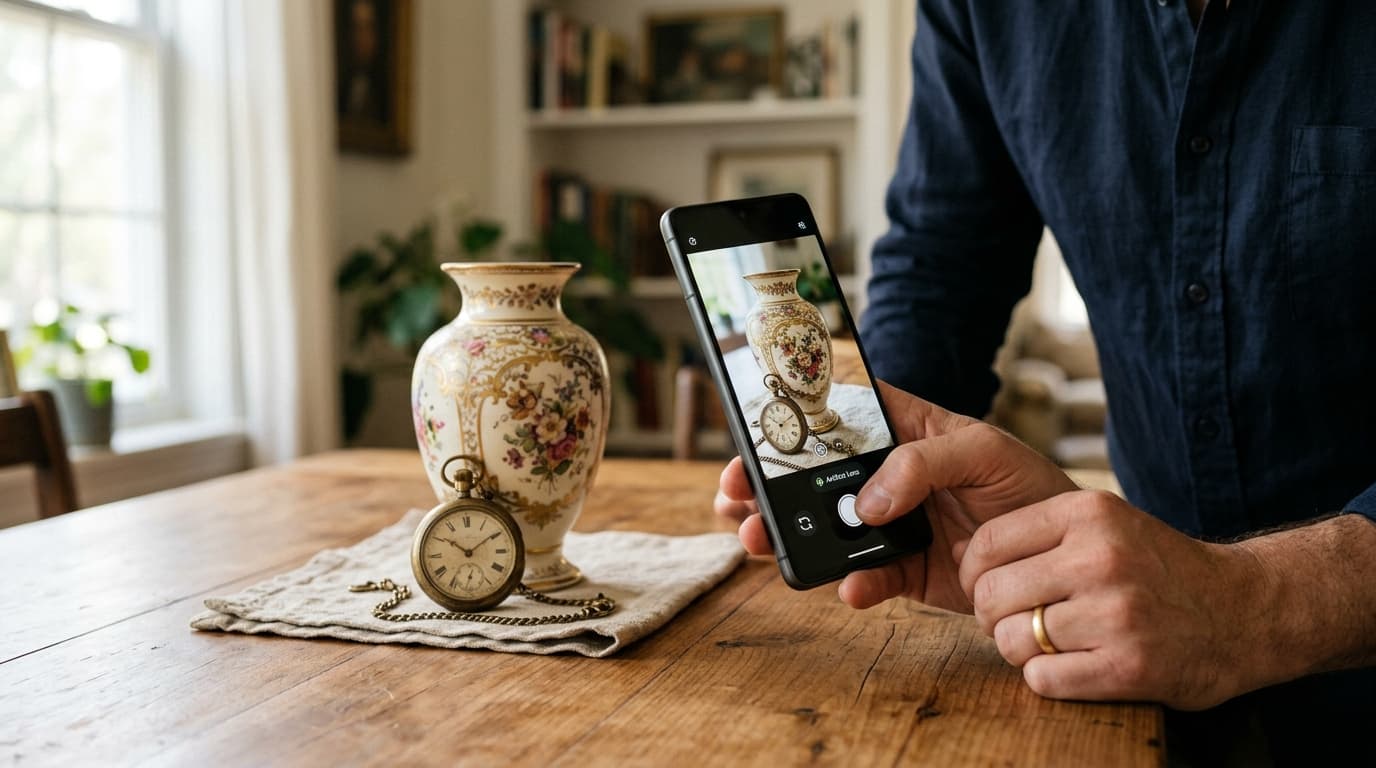
Best Antique Identifier Apps in 2026 (Honest Comparison)
If you have ever held an unmarked vase or a dusty inherited clock and wondered, "What is this, and is it worth anything?", you are exactly who antique identifier apps are built for. The honest answer to "what is the best app for identifying antiques?" is that it depends on what you need: a fast first guess from a photo, deep sold-price research, or free general lookups. Below is a straight comparison of the five tools most people actually reach for in 2026, including where each one is genuinely strong and where it falls short.
Disclosure: Histora publishes this comparison and develops one of the apps discussed. It is an AI-assisted feature overview, not an independent hands-on test or professional appraisal. No app replaces a trained eye on a high-value piece; use these tools as a starting point and verify important findings. Pricing figures are carried over from the September 2026 version and have not been rechecked for this October update.
Quick comparison table
| App | Best for | Identification approach | Pricing | Skips the appraiser? |
|---|---|---|---|---|
| Histora | Instant first estimate from a photo | AI photo recognition tuned for antiques and collectibles | Free tier / paid plan available | No — first opinion, then verify |
| Curio | Casual ID with a friendly interface | AI photo recognition | ~$7/week or ~$55/year | No |
| AntiqSnap | Quick snap-and-identify lookups | AI photo recognition | ~$3.99/week or ~$39.99/year (3-day trial) | No |
| Google Lens | Free general visual matching | General-purpose visual search | Free | No |
| WorthPoint | Deep sold-price research | Price database of past sales | From ~$29.99/month (or ~$249.99/year) | No, but strong for values |
The sections below explain the reasoning behind that table so you can pick the tool that fits your situation rather than just the one with the loudest marketing.
What an antique identifier app can and cannot do
Before comparing tools, set expectations. AI identifier apps are good at pattern recognition. Show one a photo and it can often tell you the likely category, era, style, and sometimes the maker, especially when there is a visible mark. That is genuinely useful when you are staring at something you cannot name.
What no app does reliably is hand you an exact, defensible dollar value. Value depends on condition nuances, authenticity, provenance, and live demand that a single photo cannot capture. These apps are best treated as the "first opinion" step. They tell you whether to keep digging. For the mechanics of getting a clean result, see our guide on how to identify an antique from a photo.
Histora — best for an instant first estimate
Histora is an AI-powered antique identifier built specifically around antiques and collectibles rather than general object recognition. You photograph an item, and it returns a likely identification along with context about era, style, and what tends to drive value up or down for that type of object.
Where it shines: speed and approachability. For someone clearing an estate or curious about a flea-market find, getting a reasoned first read in seconds is exactly the right starting point. Because the model is oriented toward collectible categories and makers' marks, its prompts and context tend to be more antique-relevant than a general image search.
Honest limitations: like every AI tool, Histora is making an educated inference from pixels. Unusual, heavily worn, or unmarked pieces can confuse any model, and it does not issue formal appraisals. Treat it as a starting point for further research. Histora offers a free tier so you can evaluate it on your own items before paying.
Use Histora to answer "what is this and roughly what category of value am I in?", then verify the specifics with sold-price data.
Curio — friendly casual identification
Curio is another AI photo-identification app aimed at hobbyists and casual users who want a clean, approachable experience. If you prefer a simple "snap and learn" flow over a research-heavy interface, it is worth a look.
Where it shines: ease of use and a low-friction onboarding for beginners who are not ready for a dense database tool.
Honest limitations: as with all single-photo AI tools, accuracy varies with image quality and how distinctive the item is, and it is not a valuation authority. Weigh its clean, beginner-friendly flow against the thinner research depth of a database tool. As of writing it runs roughly $7/week or $55/year; our full Curio antique identifier review breaks down the free tier, the billing traps, and how it compares head-to-head.
AntiqSnap — quick snap-and-identify
AntiqSnap follows the same broad model: photograph an item and receive an AI-generated identification. It competes in the same casual-identifier lane as Curio and Histora.
Where it shines: fast lookups for everyday curiosity, with a straightforward capture-and-result flow.
Honest limitations: the usual caveats about single-image AI inference apply, and you should not treat its output as a valuation. It competes closely with Curio and Histora, so the right pick comes down to which capture-and-result flow you prefer. As of writing it lists around $3.99/week or $39.99/year; our AntiqSnap review digs into whether it is free, whether it is legit, and what the subscription actually gets you.
Google Lens — the free generalist
Google Lens is not an antiques app, and that is precisely its strength and its weakness. It is a free, general-purpose visual search that finds similar images and web results across the entire internet.
Where it shines: it is free, fast, and excellent for finding visual matches, especially when a near-identical item is already pictured somewhere online. For identifying a logo, a pattern, or pairing a mark to an existing listing, it can be remarkably effective.
Honest limitations: because it is general-purpose, it has no specialized understanding of antique categories, makers' marks conventions, or collectible value drivers. Results can be a scattershot of shopping links and unrelated images, and it offers no valuation context. One approach is to use Lens as a free first sweep and then cross-check with a dedicated antiques tool.
WorthPoint — best for deep value research
WorthPoint is a different animal. Rather than identifying from a photo, it is built around a large database of past sales and price guides. You search by keyword, maker, or pattern and study what comparable items have actually sold for.
Where it shines: research depth. When you already know roughly what an item is and need to understand realistic value, a database of historical sold results is enormously more reliable than any single AI guess. For serious buyers and sellers, this is the gold-standard category of tool.
Honest limitations: it is research-first, not snap-and-identify. There is a learning curve, the most useful access is subscription-based (around $29.99/month or $249.99/year as of writing), and you generally need to know what you are searching for before it helps. It complements an identifier app rather than replacing it.
A suggested workflow for combining these tools
You can combine the tools in four steps:
- Identify fast. Snap the item with an AI identifier like Histora to get a likely maker, era, and category in seconds.
- Cross-check for free. Run the same item through Google Lens to see if a visual match already exists online.
- Research the value. Take the identification and search WorthPoint or live and sold marketplace listings to ground your value expectations in real numbers.
- Escalate when it matters. If the trail suggests real money, get a professional appraisal before you sell or insure.
This layered approach is also why a free starting point matters. You can begin the whole process at no cost, stretching free tools — photo identifiers, Google Lens, and sold-listing lookups — as far as they will reasonably go before you pay for anything.
So which app is "best"?
If you want one honest takeaway: there is no universal winner, but there is a best tool for each job.
- Fastest first estimate from a photo: a dedicated AI identifier such as Histora.
- Free general visual lookups: Google Lens.
- Deepest value research: WorthPoint.
- Casual, friendly identification: Curio or AntiqSnap, depending on which interface you prefer.
For most people the practical answer is to start with a free, fast identifier to learn what you are holding, then verify with sold-price data before making any financial decision. An app gives you a confident direction in seconds; your own follow-up research and, when the stakes are high, a qualified appraiser, give you certainty.
Frequently Asked Questions
Identify your antique instantly
Snap a photo with Histora to get an instant first estimate of your item's value, origin, and history — then dig deeper with the guides above.