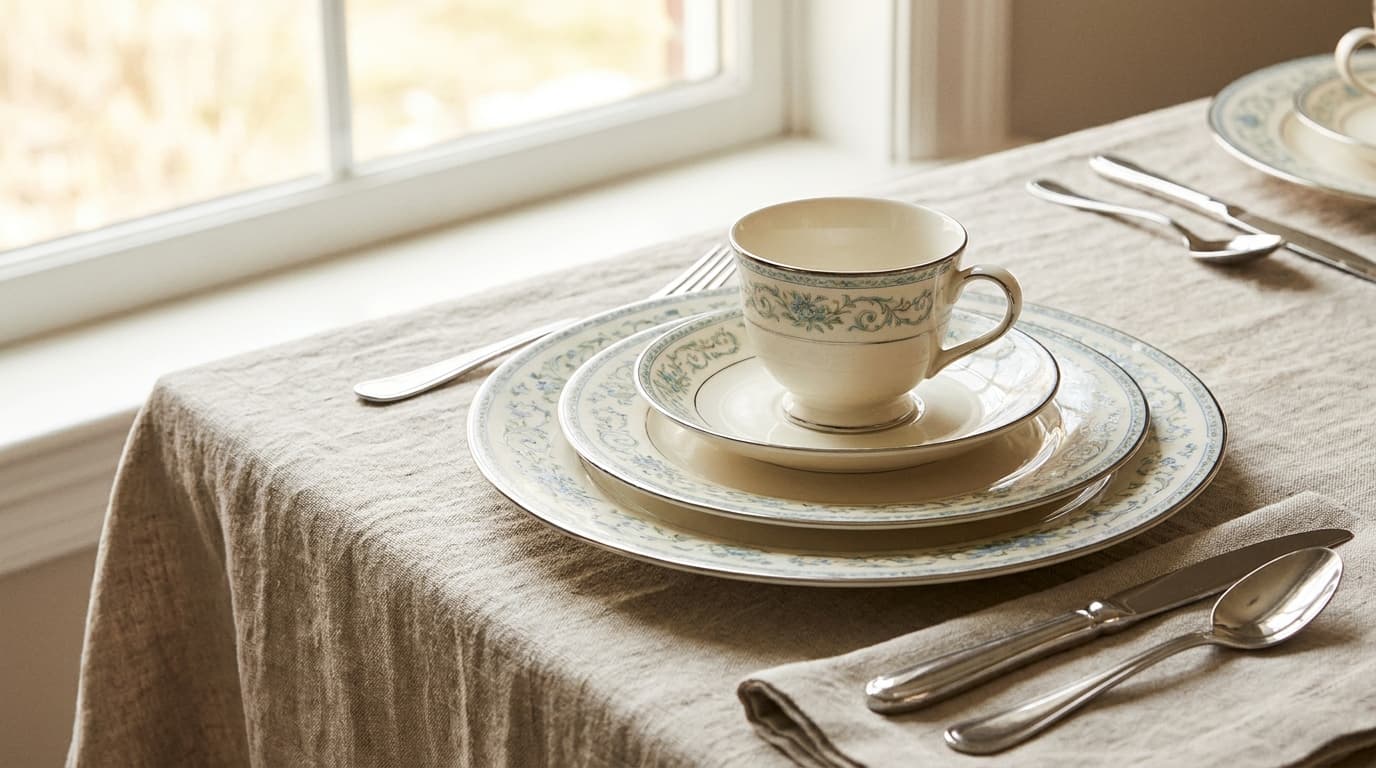
Discontinued Mikasa China Patterns Worth Money (2026)
If you inherited a Mikasa dinner set or pulled a stack of plates from an estate sale, the first question is usually the same: are these worth anything, or is it just nice old dishware? The honest answer is that a handful of discontinued Mikasa china patterns are worth money, but most are not. Value lives in scarcity and ongoing demand, not in age or brand name alone. This guide shows you how to identify exactly what you have, read the backstamp, find the pattern name and number, and judge whether collectors are still chasing your pattern.
Mikasa is a fitting starting point because it produced thousands of patterns across many body types and decades. That variety is good news and bad news: there is a real chance your pattern is sought after, but you have to identify it precisely before you can value it. For the broader framework of dating and pricing tableware, the antique and vintage china patterns identification hub covers the cross-brand fundamentals that apply here too.
A quick history: why Mikasa patterns vary so much
Mikasa is an American-founded tableware brand that sourced and distributed dinnerware made in Japan and later in other countries. Because it operated as a design and marketing house across a long span of the 20th century, it cycled through enormous numbers of patterns, retiring and replacing them on a regular schedule. That constant turnover is the entire reason "discontinued" Mikasa patterns exist in such volume.
It also means age is a weak signal of value. A Mikasa pattern from the 1970s and one from the 2000s can both be discontinued, yet only one might have a following. What separates them is how popular the pattern was when it sold, how much decoration it carried, and whether owners are still trying to complete or repair their sets today.
How to identify Mikasa china: backstamps first
Every serious identification starts on the underside of the piece. Flip a plate, bowl, or cup and look at the backstamp — the printed maker's mark. Mikasa backstamps are unusually informative compared to many tableware brands, and they typically give you three things:
- The Mikasa name and logo, confirming the maker.
- The pattern name in plain text, often directly below or beside the logo.
- A shape or body-type line plus, frequently, a pattern number (sometimes shown as a letter-and-digit code).
Read all of the printed text, not just the big logo. The pattern name is the single most valuable clue you have, because it lets you look up the exact line in a replacement-service catalog and compare against confirmed photos.
What the body-type wording tells you
Mikasa backstamps often state the body type, and that wording matters for value:
| Backstamp wording | What it means | Value tendency |
|---|---|---|
| Bone China / Fine China | Translucent, higher-fired body | Generally holds value better |
| Porcelain | Hard, vitrified body | Often desirable, depends on pattern |
| Ivory / Ivory China | Cream-toned stoneware body | Common; value depends on pattern demand |
| Casual / Stoneware / Intaglio | Heavier everyday body | Usually lower resale value |
This is a tendency, not a rule. A wildly popular casual pattern can outsell a forgettable bone-china one. But all else equal, the finer bodies carry a value edge.
When the backstamp is worn or missing
Decades of dishwasher cycles can erase a backstamp. If yours is unreadable, identify by sight instead: note the rim shape, the trim color (gold, platinum, or plain), the band pattern, and any central motif like florals, geometrics, or a specific border design. Then match those features against catalog images from a china replacement service. Reading marks is a skill that transfers across all tableware — the makers' marks and hallmarks guide covers the general approach when a stamp is partial or ambiguous.
Which discontinued Mikasa patterns collectors seek
There is no single "rare Mikasa list" that stays fixed, because demand shifts as sets age out and owners pass on. But the types of discontinued patterns that consistently attract buyers share clear traits:
- Former wedding-china lines. Patterns that were popular bridal-registry choices decades ago now have a large installed base of owners trying to complete or repair sets. That sustained replacement demand is the strongest single driver of resale value.
- Heavily decorated and metallic-trimmed patterns. Generous gold or platinum banding, intricate florals, and detailed borders cost more to produce, were made in smaller numbers, and are harder to replace cleanly.
- Short-run or quickly retired patterns. Limited production means fewer surviving pieces, so the few that surface meet a thin supply.
- Holiday and seasonal patterns. Christmas and seasonal Mikasa lines have a dedicated, recurring buyer base each year.
- Complete or near-complete sets with serving pieces. Platters, covered vegetable dishes, gravy boats, and lidded sugars are the items replacement buyers most often need, and they frequently outvalue the dinner plates.
For specific dollar figures on the most-traded discontinued lines: as of writing, a discontinued service for eight in a sought-after pattern typically sells in the US$150–$400 range, with premium bone-china wedding patterns reaching up to around US$500+. On the replacement market, a single discontinued dinner plate usually trades for about US$15–$35, and the harder-to-find serving pieces command more.
What actually drives Mikasa value up or down
Once you know your pattern, value comes down to a familiar set of levers. Mikasa is mass-produced tableware, so the same forces that price any antique through nine valuation methods apply directly.
Demand and replacement activity. This is the top factor for discontinued dinnerware. A pattern with thousands of owners still replacing broken pieces will outsell a scarcer pattern that nobody is trying to complete. Scarcity only creates value when demand is there to meet it.
Condition. Crazing, chips, knife scratches, and stained glaze all cut value. For Mikasa specifically, trim wear is decisive — dishwasher-faded gold or platinum makes a piece a poor match for a buyer's existing set, which is exactly who is shopping.
Completeness and piece type. Full place settings and intact serving pieces command more than loose dinner plates. Hard-to-find serving items are often the most valuable part of a set.
Body type. As noted, bone china and porcelain lines tend to hold value better than casual stoneware.
Set size. A large set in one consistent condition is easier to sell as a unit, while mismatched odds and ends are worth piecemeal value at best.
A realistic per-piece versus full-set comparison: as of writing, individual discontinued plates trade for roughly US$15–$35 each on the replacement market, so parting out a five-piece place setting one item at a time might total well under US$150. By contrast, a cohesive service for eight in the same sought pattern typically sells as a unit for US$150–$400 (and up to around US$500+ for premium bone china) — illustrating the premium a complete, consistent set carries over piecemeal sales.
Why replacement demand keeps value up
The reason any discontinued Mikasa pattern holds value is the replacement market. China replacement services exist precisely because people break a plate from a 20-year-old wedding set and want a matching one — not a different pattern. When a pattern is discontinued, the factory supply stops, but the demand from existing owners does not. That mismatch is what props up prices.
This is also why popularity-at-time-of-sale matters more than rarity in the abstract. A pattern that sold in huge volumes decades ago has a huge pool of owners today, each a potential replacement buyer. A genuinely rare pattern with almost no original owners has almost no replacement demand. Counterintuitively, the once-common bestseller can be worth more per piece than the obscure oddity.
Practically, that means your selling outlets are:
- China replacement services, which buy individual pieces — especially serving items — to resell to owners completing sets.
- Online marketplaces with completed-sale histories, so you can price against what your exact pattern actually sold for.
- Specialty dinnerware resellers who handle full sets.
Always price from your specific pattern's recent sold data, never from active asking prices, which run optimistically high.
How Histora helps
If you are staring at an unfamiliar stack of plates and cannot find or read the backstamp, Histora gives you an instant first read. Photograph a piece and the app returns a likely maker, era, and pattern direction in seconds, so you know whether you are holding common casual ware or something worth deeper research. Treat that as your starting estimate, then confirm the exact pattern name from the backstamp and verify value against real sold listings before you buy, sell, or insure. It is the fast first step, not the final appraisal.
A simple workflow to value your Mikasa
- Flip and read. Record the full backstamp: maker, pattern name, body type, and any pattern number.
- Confirm the pattern by matching rim, trim, and motif to catalog photos if the name is worn.
- Grade condition honestly — trim wear, crazing, chips, and scratches.
- Inventory the set, noting serving pieces and counting complete place settings.
- Check sold prices for your exact pattern, separating per-piece from full-set values.
- Pick the right outlet — replacement service for singles and serving pieces, full-set resellers for complete sets.
If Mikasa is your entry point into tableware collecting, the same identification discipline carries over to other mass-market lines. See the most valuable Corelle patterns guide for a parallel example of how discontinuation and replacement demand set prices in everyday dinnerware.
Identify precisely, grade honestly, and price from real sold data. Do those three things and you will know quickly whether your discontinued Mikasa is a genuine find or simply a nice set of dishes.
Frequently Asked Questions
Identify your antique instantly
Snap a photo with Histora to get an instant first estimate of your item's value, origin, and history — then dig deeper with the guides above.


Related Guides
- Item GuideAntique & Vintage China Patterns: How to Identify and Value (2026)Read guide
- Item GuideMost Valuable Corelle Patterns (Identification & Value, 2026)Read guide
- ValuationHow to Value an Antique: 9 Ways to Find What It's Worth (2026)Read guide
- IdentificationHow to Read Antique Makers' Marks & Hallmarks (With Examples, 2026)Read guide