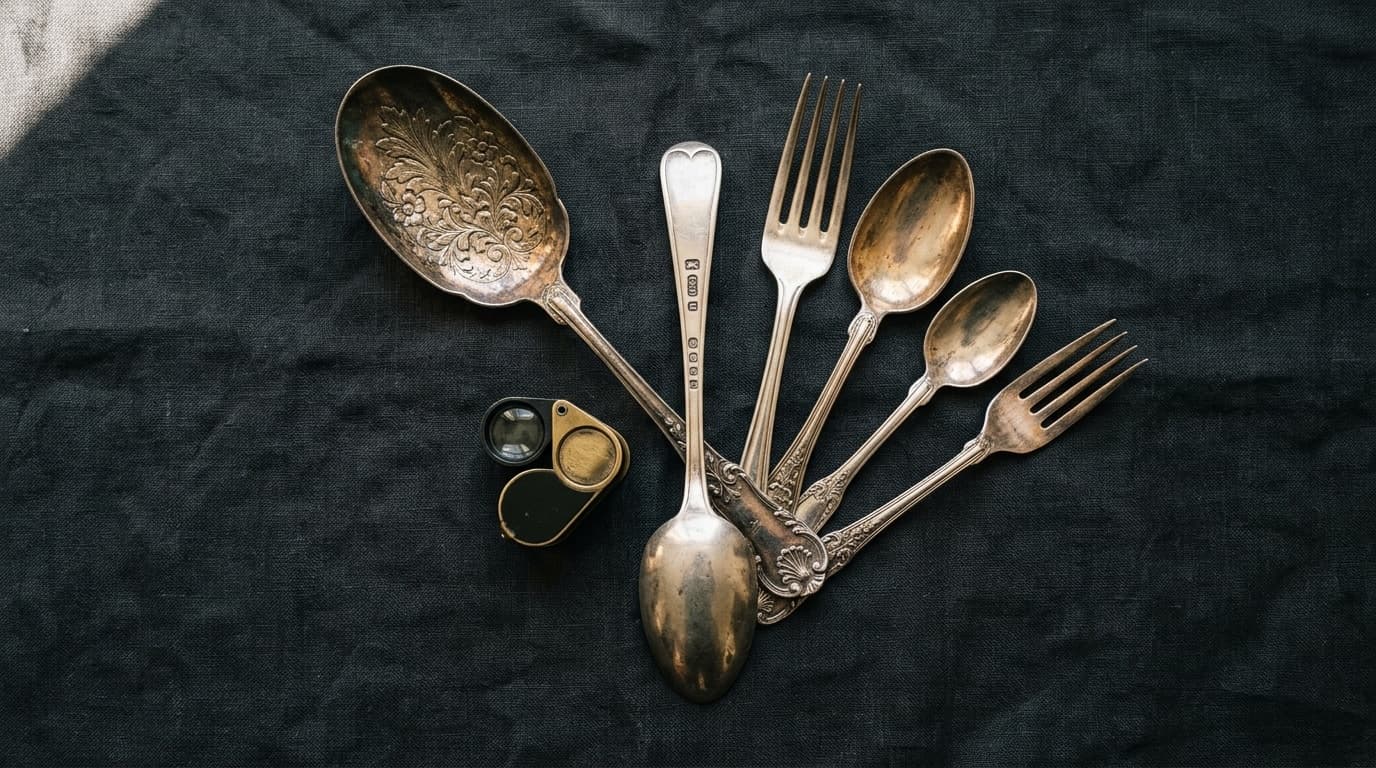
Antique Silver & Silverware: How to Identify and Value (2026)
If you've inherited a drawer of tarnished forks or found an ornate serving spoon at an estate sale, the first questions are always the same: is this real silver, who made it, and what is it worth? This guide walks you through identifying antique silver and silverware step by step — telling sterling from silverplate from coin silver, reading the hallmarks stamped on the underside, recognizing major makers and patterns, and understanding what separates a piece worth melting from one worth keeping.
The short version: real silver is marked, and those marks tell you almost everything. Learn to read them and you can sort a pile of "grandma's silver" into melt-value and collector-value piles in an afternoon.
Sterling vs. silverplate vs. coin silver
Before you value anything, you need to know what metal you're holding. There are three common categories, and the difference is enormous.
| Type | Silver content | How it's marked | Typical value |
|---|---|---|---|
| Sterling silver | 92.5% pure | "Sterling", "925", lion passant | Real melt value + collector premium |
| Coin silver | ~90% pure (US, pre-1860s) | "COIN", "PURE COIN", "STANDARD" | Melt value + collector premium |
| Silverplate | Thin silver layer over base metal | "EPNS", "Triple Plate", "A1", "Silver on Copper" | Little to no melt value |
Sterling silver is the gold standard, so to speak. At 92.5% pure silver (the other 7.5% is usually copper for strength), it carries genuine intrinsic value tied to the silver spot price, plus whatever premium its maker and pattern add on top.
Coin silver is what Americans used before sterling became standard around the mid-1800s. It's slightly less pure, often made from melted coins, and early examples by documented silversmiths are collectible in their own right.
Silverplate looks similar but is a completely different animal. It's a microscopically thin layer of silver electroplated onto a base metal like nickel or copper. There simply isn't enough silver to recover economically, so silverplate's value lives entirely in its design, maker, and decorative appeal — not its metal.
A quick physical test: sterling is noticeably heavier than plate of the same size, and at worn high points (fork tines, spoon edges) silverplate eventually reveals a yellow or coppery base metal underneath. But marks are always more reliable than feel, which brings us to hallmarks.
How to read silver hallmarks
Hallmarks are the small stamps on the back or underside of a piece. Learning to read them is the single most valuable skill in silver identification, and it overlaps heavily with the broader topic covered in our guide to reading makers' marks and hallmarks — the pillar resource for decoding any stamp you find.
"Sterling" and "925"
The easiest marks. On American and modern pieces, the word "Sterling" spelled out, or the number "925", is a straightforward purity guarantee: 92.5% silver. If you see either, you're holding real sterling. Many makers add their name or logo beside it.
The lion passant (British sterling)
On English silver you'll rarely see the word "sterling." Instead, British silver uses a formal hallmark system, and the key symbol is the lion passant — a lion shown in profile, walking, with its right forepaw raised. This stamp certifies sterling standard and has been used for centuries. Spotting the lion is your instant confirmation that a British piece is solid silver.
The full British hallmark set
A complete English hallmark is usually a row of four small stamps, each meaning something different:
- Standard mark — the lion passant, guaranteeing sterling purity.
- Town (assay office) mark — shows where the piece was tested. An anchor means Birmingham, a leopard's head means London, a crown historically meant Sheffield, and so on.
- Date letter — a single letter in a specific font and shield shape that pins the year of assay. The same letter recurs in cycles, so the font and shield matter as much as the letter itself.
- Maker's mark — the silversmith's initials, the key to attribution.
Reading all four lets you say not just "this is silver" but "this is a London piece from a specific year by a specific maker." That precision is what turns a guess into a valuation.
Maker's marks
The maker's mark — usually initials in a shaped cartouche — is what links a piece to a documented silversmith and a price history. Crisp, legible marks help value; rubbed or partial marks hurt it. American sterling typically pairs a maker's name or logo with "Sterling," while older coin silver may show only a name or pseudo-hallmarks that mimic the British style.
Silverplate marks to recognize
If you see any of these, the piece is plated, not solid:
- EPNS — Electro-Plated Nickel Silver
- EP, A1, Triple Plate, Quadruple Plate
- "Silver on Copper" or "Sheffield Plate"
- A brand name (like many hotel and railway services) with no purity number
None of these mean worthless — collectible silverplate exists — but they do mean the value is decorative, not metal.
Major makers and patterns to know
Once you've confirmed real silver and read the marks, the maker and pattern decide where a piece sits on the value scale. A few names and pattern families come up again and again in American and British flatware:
- Gorham — one of the largest American sterling houses; patterns like Chantilly and Buttercup are widely collected.
- Reed & Barton — known for ornate patterns such as Francis I.
- Towle — Old Master and other patterns with strong collector demand.
- International Silver — a major maker across many patterns and price tiers.
- Wallace — Grande Baroque and similar heavy, ornate designs.
- Tiffany & Co. — top-tier American sterling; patterns and hollowware command premiums.
Pattern matters because collectors buy to complete or extend a set. A missing dinner fork in a discontinued pattern can be worth a real premium to someone finishing their grandmother's service — far more than its silver weight alone. Identifying the exact pattern name (often findable from the design and the maker's mark) is therefore a core valuation step, and it's a good example of where photo-based tools shine. Histora can give you an instant first read on a maker's mark or pattern from a quick phone photo, which is a fast way to narrow down what you're holding before you dig into reference books or sold listings.
What drives antique silver value
Two pieces of identical weight can be worth wildly different amounts. Here's what moves the needle, roughly in order of impact:
- Maker. A top maker like Tiffany or a documented early coin-silver smith carries a premium over a generic or unmarked piece.
- Pattern and form. Rare, ornate, or discontinued patterns and unusual serving pieces (sugar sifters, fish servers, specialty ladles) outperform common patterns and plain teaspoons.
- Weight of actual silver. Heavier-gauge sterling has more intrinsic value and usually signals higher quality. Hollowware filled with cement or weighted bases is the exception — the metal is thin.
- Condition. Crisp marks, no dents, no splits at solder joints, and no over-polishing (which softens detail) all add value.
- Completeness. A full, matched service for 8 or 12 is worth more per piece than loose oddments.
- Monograms. Engraved initials usually reduce value for flatware, since most buyers want clean pieces — though historically significant monograms can occasionally add interest.
- Provenance. Documented history or a notable original owner can lift value, a factor explored in our broader guide to how to value an antique.
For ballpark figures, melt value is straightforward to estimate from weight and purity, but collector premiums vary enormously by maker and pattern.
A complete sterling service for 8 in a common Gorham or Reed & Barton pattern typically sells for roughly US$1,200–$3,000, with the most desirable patterns and an original chest at the top of that range. The melt floor sits high here — at a silver spot of about US$65/troy oz, the metal alone underpins much of the price, so these rarely sell far below melt regardless of pattern.
A single Tiffany & Co. sterling serving spoon usually carries a premium of US$80–$350 over its melt value — about 1.2–2× melt for ordinary patterns, rising to 2–4×+ for early or figural designs.
Melt value vs. collector value
This is the decision that matters most when you're ready to sell.
Melt value is the raw worth of the silver itself: weight × purity × the current silver spot price, minus a refiner's margin. Every piece of sterling and coin silver has a melt floor. It's the minimum a piece is worth, and for common, damaged, monogrammed, or unmarked flatware, melt is often the realistic ceiling too.
Collector value is what someone will pay above melt because of the maker, pattern, rarity, or history. A heavy serving piece by a sought-after maker in a discontinued pattern can sell for several times its melt value to the right buyer.
The practical rule: identify before you melt. Refiners pay melt and don't care about pattern or maker, so melting a desirable piece can throw away most of its worth. Silver flatware sits squarely within the valuable antique categories precisely because so much of it is sold for scrap when a few minutes of research would reveal a collector premium. If you are unsure what the marks on a piece mean, run them through the free hallmark identifier before you call a refiner.
A sensible workflow:
- Sort sterling/coin from silverplate using the marks.
- Photograph and identify the maker's mark and pattern on each sterling piece.
- Weigh the sterling and calculate a melt floor at the current spot price.
- Check sold listings for that maker and pattern to see whether collector value beats melt.
- Sell collectible pieces to collectors or specialist dealers, and send only the genuinely common, damaged scrap to a refiner.
As a reference point, the silver spot price was around $65 per troy ounce in mid-2026, but it moves daily — always check a live quote before you calculate a melt figure, since the number that matters is the spot price on the day you sell.
Quick identification checklist
Run through this for any piece:
- Find the marks on the back, underside, or shaft.
- Solid or plated? Look for "Sterling"/"925"/lion passant (solid) vs. "EPNS"/"Triple Plate" (plated).
- Read the full hallmark if British: lion, town, date letter, maker.
- Identify the maker from the initials or logo.
- Identify the pattern from the design.
- Assess condition: dents, wear-through, monograms, over-polishing.
- Calculate melt as your value floor, then research collector premium.
Get those seven things and you can speak about almost any piece of silver with confidence — and avoid the most expensive mistake in the category, which is scrapping something a collector would have paid a premium for.
Frequently Asked Questions
Identify your antique instantly
Snap a photo with Histora to get an instant first estimate of your item's value, origin, and history — then dig deeper with the guides above.


Related Guides
- IdentificationHow to Read Antique Makers' Marks & Hallmarks (With Examples, 2026)Read guide
- ValuationHow to Value an Antique: 9 Ways to Find What It's Worth (2026)Read guide
- Collecting TipsMost Valuable Antique Categories: Complete Collector's Guide 2026Read guide
- IdentificationHow to Identify an Antique From a Photo (Free Methods, 2026)Read guide