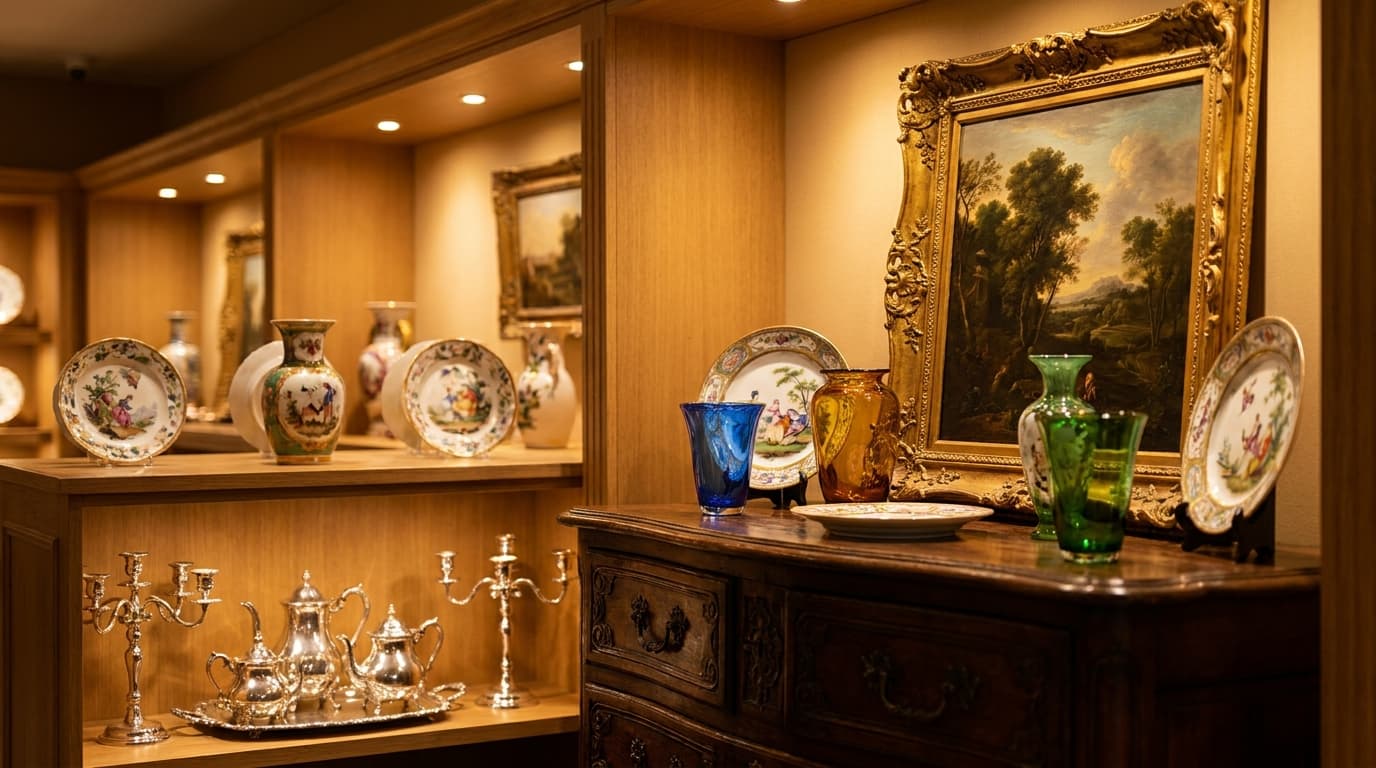
Most Valuable Antique Categories: Complete Collector's Guide 2026
Not all antiques appreciate. Some categories have climbed steadily for decades while others — including things marketed as collectibles in living memory — have gone nowhere. This guide covers the categories that reliably hold value, what to look for inside each one, and the ones worth avoiding. If you are still sorting out the terms, start with the difference between antique, vintage, and collectible.
One principle runs through everything below: within any category, maker, rarity, and condition matter far more than age. A common piece from a famous name often sells for less than a scarce piece from a minor one.
Furniture
Victorian (1837–1901)
The classic antique furniture category, and still the deepest market. Antique furniture identification here rests on three things: the wood, the carving, and whether the hardware is original.
- Mahogany dining sets — complete sets command a large premium over loose pieces
- Hand-carved chairs — carving quality separates the valuable from the ordinary
- Ornate dressers and wardrobes — original hardware and mirrors matter enormously
- Roll-top desks — hidden compartments and working mechanisms lift value
What to look for: heavy ornate carving and dark woods, typically mahogany or walnut. Check whether the hardware is original; replaced pulls are common and cost real money.
Mid-century modern (1945–1975)
The fastest-growing category of the last decade, with some pieces up several times over:
- Eames pieces — a designer label transforms the price
- Scandinavian teak — clean lines and joinery quality
- Danish modern — Wegner and Finn Juhl lead the market
- Atomic-era designs — the more distinctly of-its-moment, the better
Labels are the whole game here. An unlabelled piece in the style is worth a fraction of an attributed one.
Jewelry and watches
Art Deco (1920s–30s) is defined by geometric pattern and bold form. Platinum and diamond pieces lead, followed by coloured gemstone work, men's accessories, and costume jewelry by named designers.
Vintage watches appreciate more consistently than almost anything else on this list — vintage Rolex models, Omega Speedmasters, Patek Philippe, and American railroad pocket watches. Originality is critical: a replaced dial or bezel can halve the value of an otherwise correct watch.
Pottery and porcelain
Studio pottery
Handmade work by known artists, where the signature is most of the value:
- Art pottery from the major studios — Rookwood, Roseville, Van Briggle
- Mid-century studio ceramics — George Ohr, Beatrice Wood
- Signed work by recognised potters — always check the base
- Regional artisans — can be surprisingly strong in their own markets
Look for artist signatures, studio marks, and distinctive glaze work. Our guide to makers' marks covers how to read what you find.
Fine china
These manufacturers hold value consistently: Royal Crown Derby (intricate patterns, gilding), Wedgwood (Jasperware), Spode (English transferware), and Limoges (hand-painted French porcelain).
Complete sets with serving pieces are worth far more than the sum of individual plates — serving pieces are what break up first and what collectors hunt to complete a set.
Art and prints
Original artwork can be valuable even from lesser-known hands, particularly local artists with historical significance, period-appropriate subjects, and anything with documented provenance. Execution quality and condition drive the rest.
Vintage posters are a strong and accessible category: travel posters, pre-1960s film posters, product advertising, and political campaign material. Condition is unusually important because paper is fragile — folds, tape, and trimming all cut value sharply.
Books and documents
First editions
- Classic literature — Twain, Dickens, Hemingway lead the market
- Local and regional history — narrow interest, but devoted buyers
- Period technical manuals — aviation, automotive, early computing
- Illustrated children's books — Beatrix Potter and Dr. Seuss are the reliable names
The dust jacket rule: for mid-20th-century books, an intact jacket can multiply value several times over. The same book without one is often worth very little.
Historical documents
Papers with documented significance — Civil War and WWI military records, early American land deeds and maps, correspondence from notable companies or individuals, and identified photographs with known subjects and dates.
Provenance documentation matters more here than in any other category. An unattributed document is a curiosity; a documented one is an artifact.
Emerging collectibles
Technology has become a genuine category: early Apple and IBM machines, first-generation gaming systems, transistor radios, and camera equipment. Original packaging drives a disproportionate share of value.
Transportation covers automotive parts and accessories, early bicycle components, railroad memorabilia, and aviation items.
What to avoid
Some categories reliably disappoint:
- Mass-produced "collectibles" from the 1980s–90s — commemorative plates, figurine series, and anything sold as an investment. Manufactured scarcity is not scarcity.
- Reproductions sold as period pieces — common in furniture and pottery
- Anything without clear provenance at the higher end
- Poor condition, unless the piece is genuinely rare
How to assess a piece
- Find the marks. Signatures and manufacturer stamps are the fastest route to a maker. For silver and gold, the free hallmark identifier looks up purity and plating stamps, with modern date references for 2015–2026 and links for older hallmarks.
- Check the materials. Solid wood versus veneer, sterling versus plated silver — these distinctions often account for most of the price difference.
- Read the construction. Hand-forged detail versus machine-made components tells you both age and quality — this is the core of antique furniture identification, where joinery dates a piece more reliably than style does.
- Photograph everything — marks, signatures, damage — before you research or sell.
- Find the community. Category specialists know current prices better than any general guide, including this one.
For the full valuation method, see how to value an antique.
Trends worth watching
- Sustainability is pushing buyers toward vintage as an alternative to new production
- Generational shift — mid-century and 80s/90s nostalgia is driving demand from younger collectors
- International demand, particularly from Asian markets, has lifted several categories
- Digital provenance tracking is beginning to matter at the high end
Where to start
Pick one category and learn it properly before adding another. Depth beats breadth: a collector who genuinely knows Roseville pottery will spot value that a generalist walks past. The categories above are ranked by market reliability, not by how interesting they are — collect what holds your attention, but know which side of that line you are on.
Frequently Asked Questions
Identify your antique instantly
Snap a photo with Histora to get an instant first estimate of your item's value, origin, and history — then dig deeper with the guides above.


Related Guides
- Beginner's GuideHow to Identify Antiques: Complete Beginner's Guide for 2026Read guide
- ValuationHow to Value an Antique: 9 Ways to Find What It's Worth (2026)Read guide
- Item GuideAntique Silver & Silverware: How to Identify and Value (2026)Read guide
- IdentificationHow to Read Antique Makers' Marks & Hallmarks (With Examples, 2026)Read guide