Nippon Hand-Painted Porcelain: Identification & Value (2026)
If you've turned over a vase and found the word Nippon stamped on the base, you're holding a piece of Japanese export porcelain made between 1891 and 1921. That single word dates the object to a narrow 30-year window and tells you it was made for the American market. This guide explains what the mark means, how to read the most common backstamps, how to judge whether the painting is genuinely hand-done, how to spot the reproductions that flooded the market after the 1980s, and what actually drives the value of Nippon hand painted vases up or down.
What "Nippon" actually means
"Nippon" is simply the romanized Japanese name for Japan. It appears on porcelain because of US trade law, not because of any maker or pattern.
The 1890 McKinley Tariff Act required imported goods to be marked with their country of origin in English. US customs accepted "Nippon" as an acceptable English-language marking for Japanese imports starting in 1891. That held until 1921, when the government reversed its position, ruled "Nippon" was a foreign word rather than English, and required imports to read "Japan" instead.
The practical takeaway: a genuine "Nippon" mark dates a piece to roughly 1891–1921. Anything marked "Japan," "Made in Japan," or "Occupied Japan" is later. This date logic is one of the cleanest examples of how a single backstamp can place an object in time—the same skill you use across all porcelain, covered in our guide to reading makers' marks and hallmarks.
Reading Nippon backstamps
Nippon was never a single company. It was a marking applied by dozens of decorating studios and distributors, so you'll encounter many different symbols. The symbol identifies the importer or studio; the word "Nippon" dates it. Here are the ones you'll meet most often.
| Backstamp symbol | Typically associated with | Notes |
|---|---|---|
| M-in-wreath | Morimura Brothers (Noritake lineage) | Among the most common; "M" stands for Morimura |
| Maple leaf | Morimura Brothers, early period | One of the earliest Nippon marks |
| Rising sun | Various Japanese exporters | A rayed sun motif, often with "Hand Painted Nippon" |
| Cherry blossom | Several studios | Stylized blossom, sometimes with letters |
| RC / wreath variants | Noritake "Royal Crockery" lines | Higher-grade decorating |
| Crown / pagoda / torii | Assorted exporters | Less common; cross-reference carefully |
A few rules make backstamp reading more reliable:
- The color of the mark can hint at grade. Green marks were often used on higher-quality export lines; magenta/red and blue marks appear across the range. Color alone is not proof, but it's a clue.
- "Hand Painted Nippon" is a printed phrase, not a guarantee. It tells you the decorator's intent, not the actual quality of the brushwork in front of you.
- Match the symbol to a reference, don't guess. Two marks can look similar but belong to different studios and eras within the window.
Because so many Nippon pieces also carry decorative pattern elements borrowed from European porcelain traditions, it helps to understand the broader vocabulary of antique and vintage china patterns when you're trying to place a piece.
Judging the hand-painting
This is where collectors separate ordinary Nippon from desirable Nippon. The decoration falls on a spectrum:
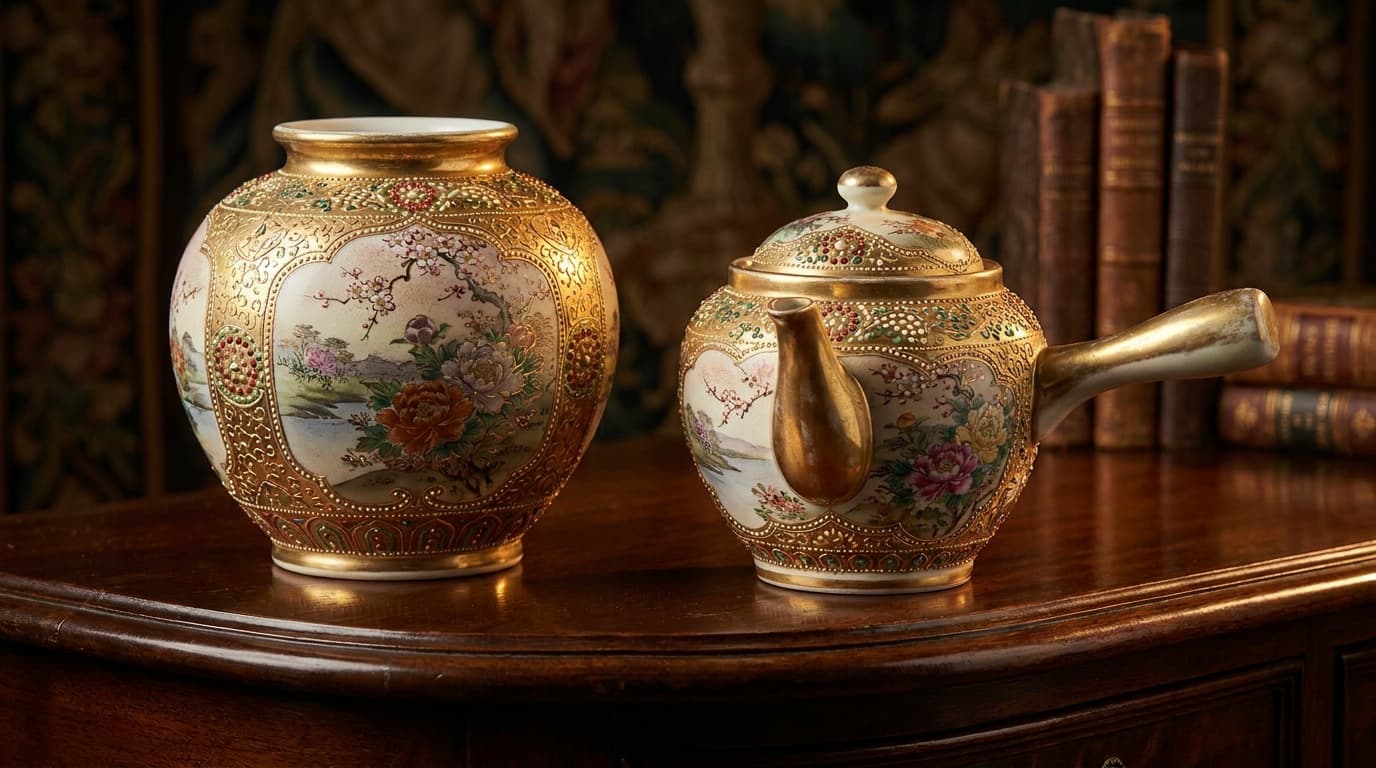
- Fully hand-painted scenes — landscapes, florals, wildlife, or portraits painted freehand by a decorator. Look for brushstroke variation, slight asymmetry, and depth in shading. This is the top tier.
- Hand-painted enamel and gilt over outline — a printed outline filled and embellished by hand. Still attractive, mid-range.
- Transfer (decal) decoration, hand-tinted — a printed image with hand-added color washes. Lowest decorating tier, even if the base reads "Hand Painted."
Hold the piece to the light and look closely. Hand-painted work shows raised, uneven pigment and the occasional stray stroke; a transfer shows a flat, perfectly repeated dot or line pattern under magnification. A jeweler's loupe is your best friend here.
Moriage and other raised decoration
Moriage is the feature that most defines high-end Nippon. It's raised, applied slip decoration—beads, ropes, scrolls, dragons, and trailing florals—built up in relief on the surface, then often gilded or enameled.
Quality signals to look for:
- Crisp, deliberate relief that holds fine detail (individual beads, defined dragon scales).
- Firm attachment with no flaking or chips along the raised lines.
- Integration with the painting, where the moriage and the painted scene work together rather than fighting each other.
Crude, blobby, or damaged moriage drags value down quickly because the relief is the labor-intensive part buyers are paying for.
Reproductions and fakes — a real warning
This is the single most important section for anyone buying. Reproduction "Nippon" marks have circulated heavily since the 1980s, and the issue was significant enough that US courts restricted certain reproduction marks in the 1990s. Modern pieces are sometimes stamped with a convincing "Nippon" backstamp to pass as century-old export ware.
Red flags that suggest a reproduction:
- The mark sits on top of the glaze and can be scratched off with a fingernail. Genuine period marks are typically under or fused with the glaze.
- Overly crisp, modern printing — laser-sharp edges, uniform ink, or a mark that looks too clean for its claimed age.
- Wrong weight or feel — many fakes are heavier and coarser, with a too-white, too-uniform body.
- "Married" decoration — an old blank decorated recently, or a recent blank with an artificially aged look.
- Anachronistic motifs or colors that don't match documented period output.
When the numbers get serious, none of this should be done from memory alone. Authenticating high-value Nippon is exactly the kind of decision where you cross-reference multiple signals—mark, glaze, body, decoration, and wear—using the same disciplined approach we lay out in how to value an antique.
How Histora helps here
If you're standing at an estate sale or scrolling listings and aren't sure whether a backstamp is even worth a second look, the Histora app gives you an instant first read from a photo—flagging the likely mark family and era so you know whether to slow down and examine the piece in person. Treat it as the fast triage step, not the final word: a confirmed high-value Nippon vase still deserves a loupe, a reference check, and ideally a specialist's eyes.
What drives Nippon value
Value is qualitative until you check real sold data, but the drivers are consistent. Higher value comes from:
- Painting quality — fully hand-painted, finely detailed scenes over decals.
- Fine moriage and gilt — abundant, crisp raised work in good condition.
- Form and size — large vases, unusual shapes, ewers, and chargers over small, common dishes.
- Scarce subjects — detailed landscapes, wildlife, and dramatic scenes over generic florals.
- A documented maker — pieces traceable to a known studio like the Morimura/Noritake lineage.
- Condition — no chips, cracks, hairlines, repairs, or worn gilt.
Value drops with damage, heavy gilt wear, repairs, plain transfer decoration, and small utilitarian forms. As a rough sense of the market:
- For a large, finely hand-painted moriage vase in excellent condition: as of writing, these typically sell in the US$150–$600 range (~10–12 in, excellent condition).
- For a common small hand-painted Nippon bowl or dish: as of writing, a typical sold range is about US$25–$100.
- For a documented Morimura/M-in-wreath scenic vase: as of writing, these typically sell for around US$150–$500 in good condition.
Always check recent eBay sold listings and auction results for your specific form, mark, and condition before pricing—Nippon spans a wide range, and two vases with the same backstamp can differ enormously based on painting and relief work. For context, Nippon sits in the mid-tier of collectible ceramics — well above everyday export china, below the prestige European factories — which is worth remembering when you weigh it against the most valuable antiques to look for in other categories.
A quick identification workflow
- Find and read the mark. Confirm it says "Nippon" (1891–1921), then identify the symbol family.
- Check the mark's integrity. Under-glaze, not scratch-off; period-appropriate printing.
- Test the decoration. Loupe it—hand-painted brushwork vs. flat transfer dots.
- Assess the moriage and gilt. Crisp and firmly attached vs. crude or chipped.
- Grade the form and condition. Size, shape, and any damage.
- Compare to real sold data before assigning a value.
Run those six steps and you'll separate a genuine, well-painted period vase from a decal piece or an outright reproduction far more reliably than the backstamp alone ever could. Nippon rewards close looking—the more you handle real examples, the faster the good ones announce themselves.
Frequently Asked Questions
Identify your antique instantly
Snap a photo with Histora to get an instant first estimate of your item's value, origin, and history — then dig deeper with the guides above.