Capodimonte & Lalique: Identifying Valuable Decorative Porcelain & Glass (2026)
Two of the most recognizable names in decorative arts — Italian Capodimonte porcelain and French Lalique glass — share a problem: both are imitated constantly, and both rely on a mark or signature that, on its own, proves almost nothing. This guide shows you how to identify genuine examples of each, how to separate them from the "style of" copies that flood resale listings, and what actually drives value up or down.
The short version: for Capodimonte, the crowned-N mark is your starting point but never your proof — the modeling and decoration tell the real story. For Lalique, the signature matters enormously, and the difference between an R. Lalique and a Lalique France mark can change everything.
Capodimonte porcelain: reading the crowned-N
The original Capodimonte factory was founded under the Bourbon kings of Naples in the 18th century. Its history is tangled — production moved, the name was revived, and over two centuries countless other makers borrowed both the style and the mark. That history is exactly why authentication is tricky.
The crowned-N mark
The classic Capodimonte mark is a letter N topped by a crown, usually painted in blue underglaze, sometimes impressed or in gold. It sounds like a clean identifier. It is not.
The crowned-N has been applied by German factories, later Italian workshops, and modern decorative producers for well over a century. Finding it tells you the maker wanted you to think Capodimonte — nothing more. To read marks like this with confidence, see our guide to makers' marks and hallmarks, which explains how to weigh a mark against the object itself rather than trusting it in isolation.
Other marks you may encounter:
- An impressed or blue fleur-de-lis (associated with some early Naples production).
- Workshop names or "Made in Italy" stamps on 20th-century pieces.
- No mark at all — many genuine and many style pieces are unmarked.
Genuine vs "Capodimonte-style"
Because the name is unprotected in the way a modern trademark would be, most pieces sold today are honestly described as Capodimonte-style: made in the tradition, often in Italy, but well after the original factory's era. That is not fraud — it is a category. The problem only arises when a style piece is presented as an 18th- or 19th-century original.
Look at the modeling and decoration rather than the mark:
| Feature | Leans genuine / higher quality | Leans late style piece |
|---|---|---|
| Applied flowers | Hand-modeled petal by petal, fine and varied | Repetitive, thick, mold-cast looking |
| Figures | Crisp faces, individual fingers, lively poses | Soft, generic, simplified features |
| Paste / body | Fine, white, translucent where thin | Heavy, chalky, or grayish |
| Painting | Controlled, shaded, confident brushwork | Flat, hurried, or printed-looking |
| Wear | Consistent with claimed age | Suspiciously pristine for an "antique" |
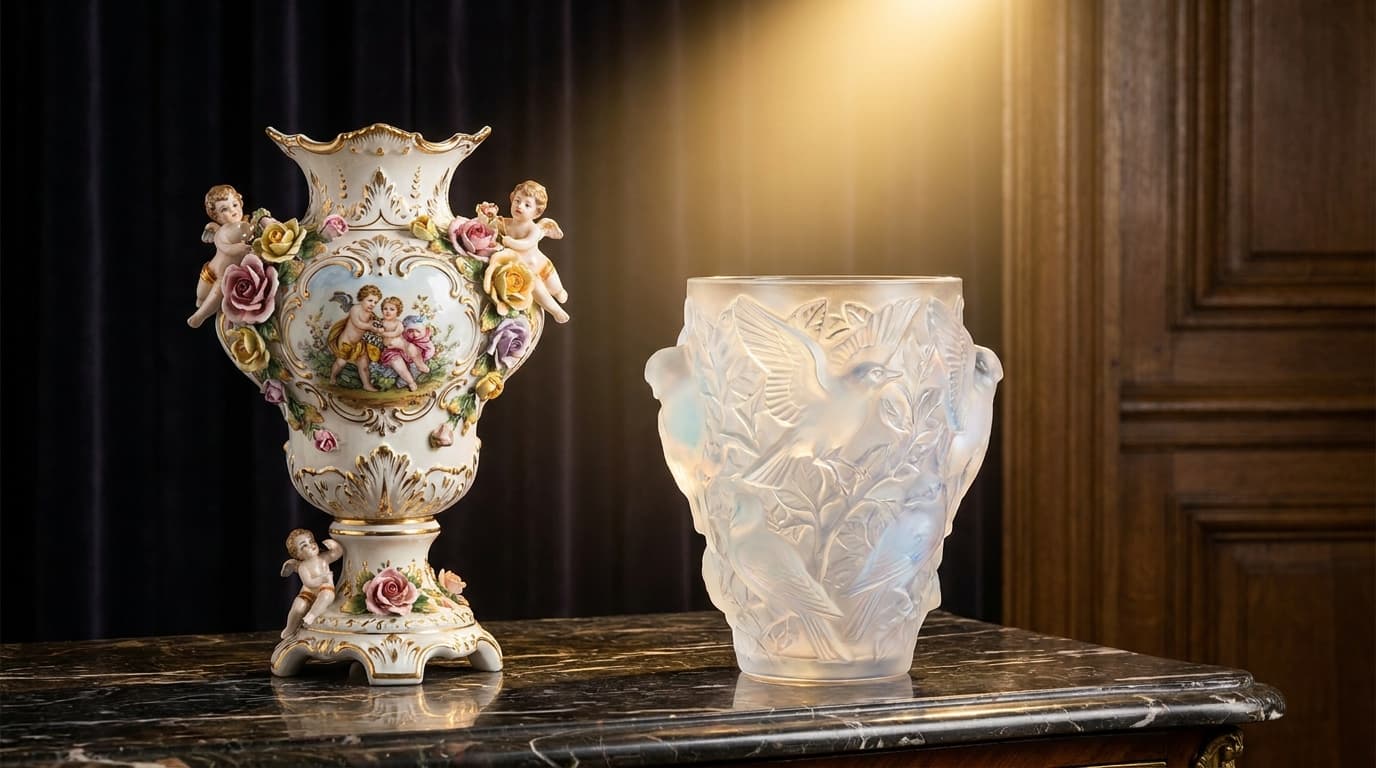
Capodimonte's signature is its hand-modeled applied florals and figural groups — bowls, urns, lamps, and chandeliers encrusted with tiny three-dimensional flowers, plus cherubs, courting couples, and mythological scenes. The quality of that handwork is the single most useful authentication signal.
What drives Capodimonte value
- Age and origin — documented early Naples or early-revival pieces sit far above generic later production.
- Modeling quality — finer, more intricate, clearly hand-built work is worth more.
- Artist signatures — some 20th-century pieces are signed by the modeler, which adds value.
- Condition — applied flowers and fingers chip and snap easily; losses hurt value significantly.
- Size and complexity — a large Capodimonte chandelier with hundreds of intact applied flowers is a different proposition from a small dish.
Because so much depends on hand-assessing the paste and the modeling, run any promising piece through a full valuation process before assuming an "antique" find is early or rare.
Lalique glass: signatures are everything
French glassmaker René Lalique turned industrial molded glass into art, and the firm he founded still produces today. With Lalique, the signature is a primary authentication tool — far more reliable than the Capodimonte mark — because the form of the signature is closely tied to the production period.
R. Lalique vs Lalique France
This is the distinction that decides value:
| Signature | Meaning | Collector demand |
|---|---|---|
| R. Lalique | Made during René Lalique's lifetime (before 1945) | Highest |
| Lalique France / Lalique (no R) | Generally post-1945 production | Genuine, but lower than pre-war |
The presence of the R initial is the headline. An R. Lalique mark points to the pre-war, René-era output that serious collectors chase. A plain Lalique or Lalique France signature is still authentic factory glass — just from the later era and, typically, more available.
Signatures appear engraved, molded, etched, or as part of the design, and the exact style (script vs block, with or without "France") shifts across periods. Match the signature style to the era the piece claims, the same disciplined way you would cross-check any maker's mark.
Frosted glass, birds, and paperweights
Lalique's visual signature is the contrast between frosted (satin) and polished clear glass. Crisp, deep molding picks out feathers, scales, petals, and figures; the frosting catches light against polished highlights. That interplay is hard to fake well.
The firm's animal subjects are especially collectible:
- Lalique birds — sparrows, doves, and similar figures, prized for the crisp feather modeling.
- Lalique paperweight forms — birds, fish, and other compact animal subjects that display the frosted-and-clear technique in a small, collectible object.
- Color variants — some pieces appear in tinted or opalescent glass, which can lift desirability above the standard clear-and-frosted version.
How to spot Lalique fakes
Counterfeits and misattributions are common. Warning signs:
- Soft, blurry detail. Genuine Lalique molding is sharp; fakes lose definition in feathers and edges.
- A wrong signature. A signature that looks acid-stamped or laser-etched onto an otherwise dull piece, or an R. Lalique mark on a form that style and quality say is modern, is a red flag.
- Even, dull frosting. Authentic frosting works with polished areas for contrast; an all-over matte haze is suspect.
- Over-polishing. A signature softened or partly removed by aggressive polishing both hurts value and obscures authentication.
When the molding is crisp, the frosted-to-clear contrast is deliberate, and the signature matches the claimed period, the case for authenticity is strong.
What drives Lalique value
- Era — R. Lalique (pre-1945) over later Lalique France.
- Subject and rarity — uncommon models and discontinued designs outperform staples.
- Color — original tinted or opalescent glass can command a premium over plain clear-and-frost. A common genuine Lalique France bird or paperweight typically sells in the US$120–$400 range, while larger or scarcer models — and pieces in desirable opalescent or tinted glass — climb toward US$800–$1,300 or more.
- Condition — chips, internal cracks (check the base and thin extremities), and signature wear reduce value sharply.
- Completeness — original stoppers, fitments, and boxes help.
For a sense of where pieces like these sit among broader high-value finds, it helps to know the most valuable antiques to look for across categories.
Capodimonte vs Lalique: how authentication differs
| Capodimonte | Lalique | |
|---|---|---|
| Primary signal | Modeling / decoration quality | Signature + molding crispness |
| Mark reliability | Low (crowned-N widely copied) | High (signature tied to era) |
| Key value split | Genuine early vs later "style" | R. Lalique vs Lalique France |
| Biggest fake tell | Generic, mold-cast florals/figures | Soft detail, wrong signature |
| Fragility risk | Chipped applied flowers | Chips, cracks, polished signature |
The lesson: with Capodimonte, trust your eyes over the mark; with Lalique, the signature is central but must be backed by molding quality.
How Histora helps
If you have a piece in hand and don't know where to start, Histora can give you an instant first read. Photograph the mark or signature and the overall form, and the app returns a likely maker, style, and era — a fast way to tell whether you're probably looking at early Capodimonte, a later style piece, or R. Lalique versus Lalique France. Treat that as your first estimate, not a final appraisal: for anything that looks high-value, confirm with a specialist or auction house, since paste quality and signature authenticity often need an in-hand assessment. You can also start from a single image using our identify an antique from a photo walkthrough.
Bottom line
Both names reward a careful eye. For Capodimonte, the crowned-N opens the conversation but the hand-modeled florals and figures settle it — and most pieces are honestly "style," not 18th-century originals. For Lalique, read the signature first (R. Lalique for the pre-war pieces collectors prize, Lalique France for later production), then confirm with the crisp, frosted-and-clear molding that copies struggle to match. Get those two habits right and you'll separate the genuinely valuable from the merely decorative.
Frequently Asked Questions
Identify your antique instantly
Snap a photo with Histora to get an instant first estimate of your item's value, origin, and history — then dig deeper with the guides above.