How to Tell If Something Is an Antique (Beginner's Guide, 2026)
If you have ever picked up an old plate, chair, or watch and wondered "is this an antique?", the short answer is this: an item is generally considered antique when it is at least 100 years old. To tell whether something crosses that line, you read its physical clues — how it was built, what it is made of, how it has aged, and any marks it carries — and you check whether those clues point to a date a century or more ago.
No single clue settles it. The skill is in stacking several clues together until they agree. This guide walks you through the markers a beginner can actually check at the kitchen table, gives you a quick checklist, and shows where a photo-based tool fits into the process. For a broader walkthrough of the whole identification workflow, see our beginner's guide to identifying antiques.
First, get the definition straight
The word "antique" gets used loosely, so pin it down before you investigate:
- Antique — roughly 100 years old or older. Many dealers and customs authorities use this 100-year line.
- Vintage — usually 20 to 99 years old, and characteristic of its era.
- Collectible — desirable to collectors regardless of exact age.
These categories overlap and people mix them up constantly, so it is worth understanding the distinctions in detail. We break them down in antique vs vintage vs collectible. For now, hold onto the 100-year rule of thumb — your goal is to decide whether the evidence puts the item before or after that line.
A second thing to fix in your mind early: age is not value. Plenty of genuine antiques are common and inexpensive, and plenty of newer items command strong prices. Identify first; research value as a separate step.
The five clue categories
Almost everything you can check falls into five buckets. Work through them in order.
1. Age markers (the date evidence)
Start with anything that directly suggests a date:
- Stamped or printed dates — patent dates, "Made in" country-of-origin labels, registry numbers, and import marks. Note that a patent date is the date of the patent, not necessarily when your item was made.
- Country-of-origin wording — labeling laws changed over time. Phrases like "Made in [Country]" became common after origin-marking rules tightened in the early 20th century, which helps you separate "before" from "after" a known threshold.
- Style and design — furniture, ceramics, and jewelry follow recognizable period styles. Matching the silhouette and ornamentation to a known era gives you a ballpark date even with no stamp at all.
Treat these as starting estimates, then confirm them against the physical construction.
2. Construction clues (how it was made)
This is where beginners gain the most ground, because manufacturing methods changed at known points in history.
For furniture and wooden objects:
| Clue | Older / more likely antique | Newer |
|---|---|---|
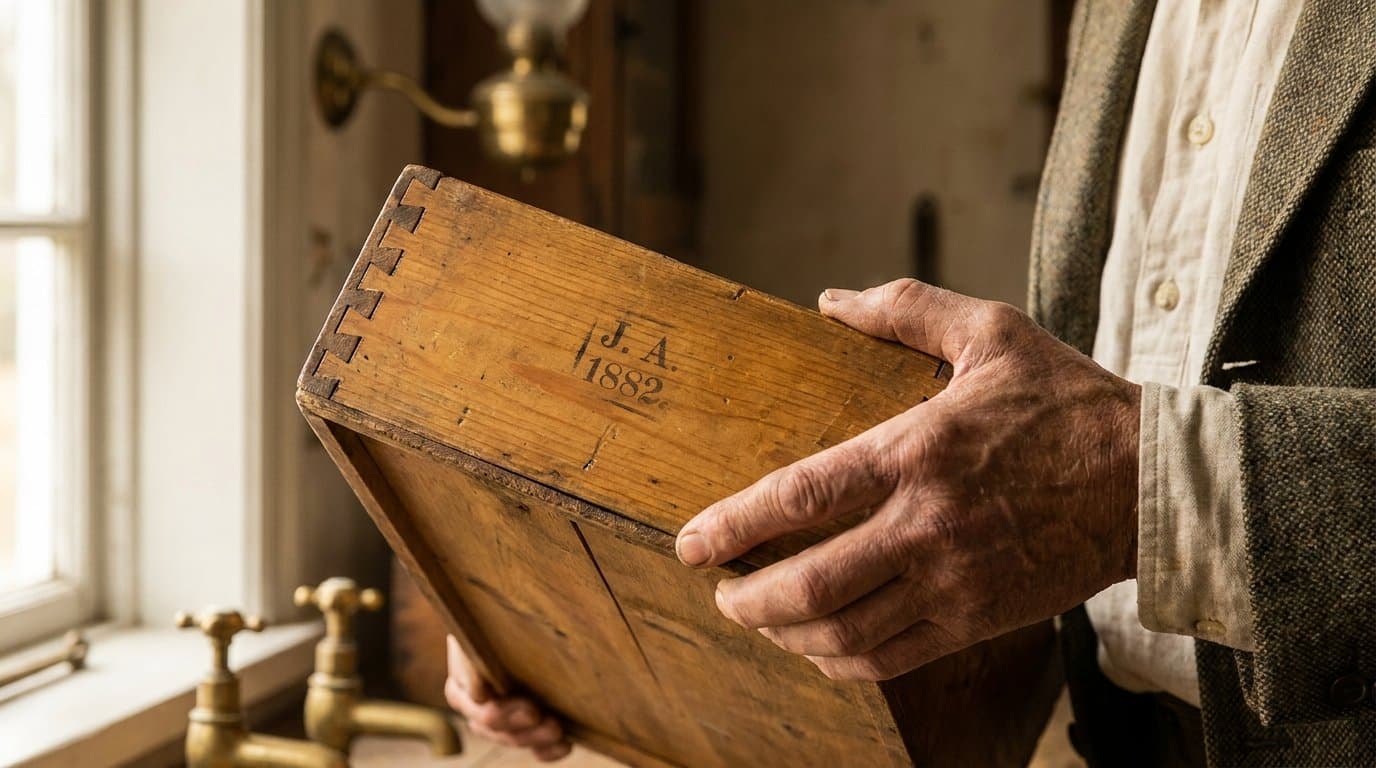
| Joinery | Hand-cut dovetails (uneven, few in number) | Machine-cut dovetails (perfectly even) |
| Saw marks | Straight or irregular hand-saw marks | Circular saw arcs (later mechanization) |
| Fasteners | Hand-forged or early cut nails; irregular screws | Uniform modern wire nails and screws |
| Back panels | Solid wood, often with shrinkage gaps | Plywood, MDF, particleboard |
| Symmetry | Slight irregularity, tool marks | Machine-perfect symmetry |
For ceramics and glass: look for a ground or polished pontil mark on the base of hand-blown glass, mold seams (and where they stop), and the crispness of any molded detail. Hand-finishing usually points earlier; perfectly uniform machine output points later.
The principle is always the same: hand work and early machinery leave traces that mass production erases.
3. Materials
What an item is made of, and how, narrows the date:
- Wood — older pieces often use solid hardwoods (oak, walnut, mahogany) rather than veneers over engineered board. Engineered materials like plywood, MDF, and particleboard are modern tells.
- Glass — color, weight, and the presence of bubbles or a pontil mark all carry date information.
- Metals and plating — solid silver versus silver plate, brass versus modern alloys; the finish and how it tarnishes matters.
- Plastics — early plastics such as Bakelite behave differently from modern plastics, which alone can place an item in the early-to-mid 20th century.
A material that simply did not exist before a certain decade is one of the cleanest ways to say "this is not an antique."
4. Wear patterns and patina
Genuine age leaves honest, consistent wear — and that consistency is the hard part to fake.
- Patina — the soft, settled surface that builds up over decades on wood, metal, and stone. It is uneven in a logical way: darker in recesses, lighter where hands and cloths have touched.
- Wear in the right places — chair stretchers worn where feet rest, drawer runners worn smooth, table edges softened. Wear should match how the object was actually used.
- Oxidation — old metal oxidizes and old wood darkens unevenly. A piece that is uniformly "aged" all over, including in spots that would never be touched, is suspect.
Beware artificially distressed reproductions. Ask whether the wear makes sense for the object's use. Random scuffs in places a hand never reaches are a red flag.
5. Maker's marks and hallmarks
Marks are powerful but tricky. A backstamp, hallmark, signature, or symbol can identify the maker and bracket a date range — but only if you match the exact version of the mark, because makers changed their marks over time and others copied them.
- Match the mark style, not just the name. The same factory used different stamps in different decades.
- Watch for "too perfect" marks — a crisp, modern-looking mark on an otherwise old item suggests a reproduction or a fake.
- Silver hallmarks in particular follow structured systems that can pin a date and origin precisely once you learn to read them.
This is a deep topic in its own right, so when you find a mark, work through our guide to reading makers' marks and hallmarks to decode it properly.
A beginner's checklist you can apply today
Run any unknown item through these questions:
- Is there a date, patent number, or origin label? Record it as a starting estimate, not proof.
- How is it joined and fastened? Hand-cut joinery and irregular fasteners lean older.
- What is it made of? Any modern-only material rules out "antique" immediately.
- Does the wear make sense? Patina and wear should match real-world use and be uneven in logical ways.
- Is there a maker's mark? Match the exact mark to documented date ranges.
- Do the clues agree? If most signals point to 100-plus years, you likely have an antique. If they conflict, trust the construction and materials over a stamped date.
The decisive idea: convergence. One clue is a guess. Four clues pointing to the same era is an identification.
Take a photo, then verify
Before you go deep on every clue, it helps to know roughly what you are looking at. This is where a photo-based tool saves time: snap clear, well-lit images of the whole item, its construction details, and any marks, and let an app give you an instant first estimate of what it is and its likely era.
Histora is built for exactly this moment — point your phone at the piece and it returns a first read on the item and period in seconds, so you know which clues and reference marks to chase down next. For tips on capturing photos that actually produce a useful result, see how to identify an antique from a photo.
Treat that estimate as a smart starting point, not a verdict. The app narrows the field; the physical checks in this guide — construction, materials, wear, and marks — confirm it. Used together, you move from "no idea" to a defensible identification quickly.
Once you know it is an antique
Identifying the item and its era is step one. Whether it is worth anything is a separate question that depends on maker, rarity, condition, demand, and provenance — not age alone. A clean attribution, an intact original finish, and documented history all push value up, while damage, repairs, and reproductions push it down.
If you want a sense of what your identified piece might be worth, gather the maker, pattern, and condition details first, then research comparable items.
Keep in mind that the spread within a single category can be enormous: rare examples often sell for many times the price of common ones in the same category, so a piece that looks superficially similar to a high-value one may still be worth a small fraction of it once maker, rarity, and condition are accounted for.
The takeaway
To tell if something is an antique, you are really answering one question — was this made at least 100 years ago? — using five lines of evidence: age markers, construction, materials, wear, and marks. Check each, look for the clues to converge on the same era, and let a photo-based first estimate point you in the right direction before you confirm by hand. With practice, the checklist becomes second nature, and you will trust your own eye instead of guessing.
Frequently Asked Questions
Identify your antique instantly
Snap a photo with Histora to get an instant first estimate of your item's value, origin, and history — then dig deeper with the guides above.


Related Guides
- Beginner's GuideHow to Identify Antiques: Complete Beginner's Guide for 2026Read guide
- Beginner's GuideAntique vs Vintage vs Collectible: What's the Difference? (2026)Read guide
- IdentificationHow to Read Antique Makers' Marks & Hallmarks (With Examples, 2026)Read guide
- IdentificationHow to Identify an Antique From a Photo (Free Methods, 2026)Read guide